
By Catherine Jacobi
A comet, a schoolboy king and a Spitfire named for a queen: how the women of Tonga turned barkcloth into a record of the moments their islands chose to remember.
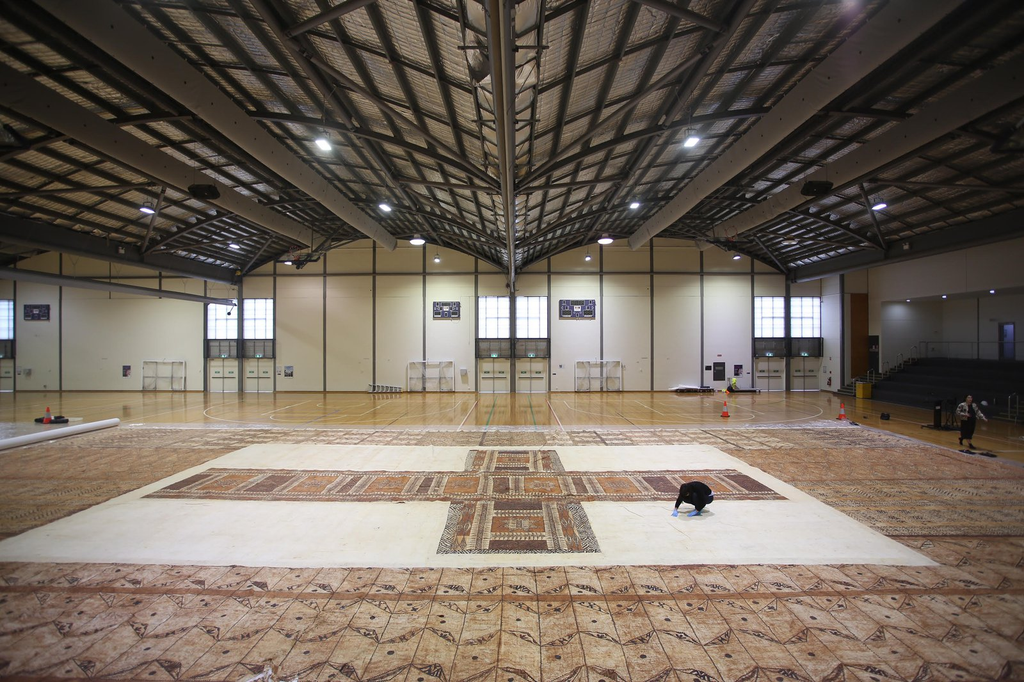
Photo: James Alcock, 2023. © Australian Museum.
On the morning of June 9, 2023, two cranes lifted a heavy roll from the Australian Museum’s storage facility in Castle Hill. A semi-trailer then carried it to the Blacktown Leisure Centre, in a part of Western Sydney that many Pacific Island families call home.
Unrolled across the floor, it measured 29 by 15 meters.
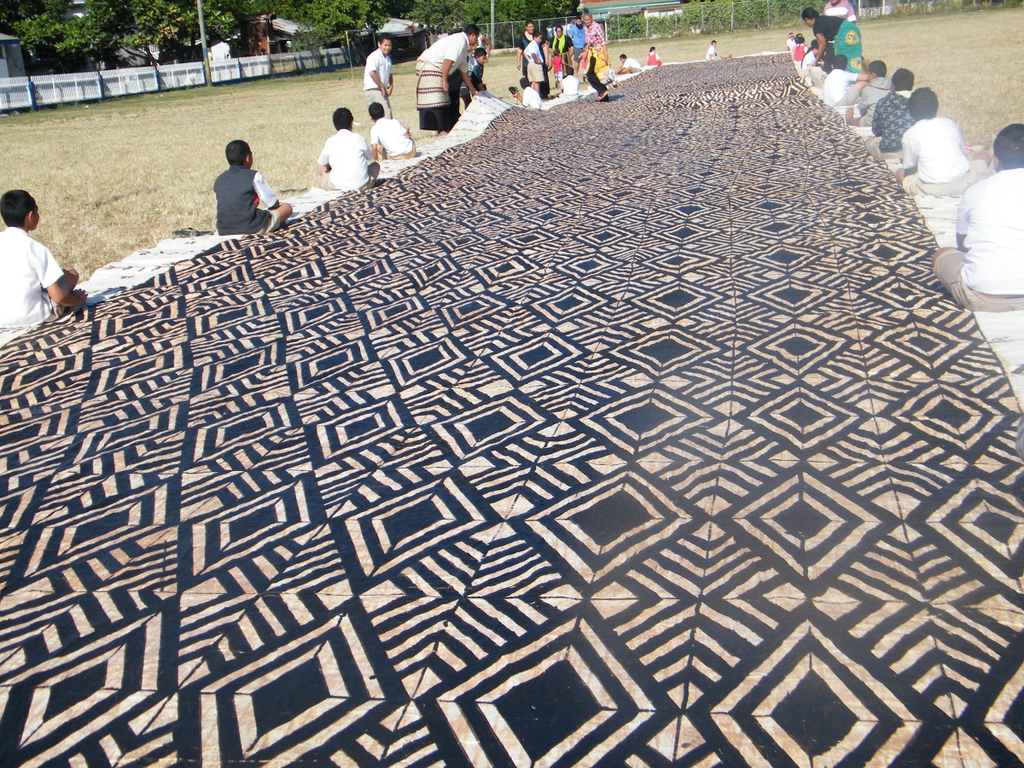
Nukuhetulu Koka’anga, 2017. ICHCAP, via Google Arts & Culture.
The people of Tonga had given it to the Sydney Opera House Trust for the building’s opening by Queen Elizabeth II in 1973, and it was used during the ceremonies. Too large and too fragile to remain there, it was transferred to the museum, where it stayed rolled for half a century. Princess Angelika of Tonga came to see it fully opened again.
Its name is Ngatu Me’a’ofa, which the museum translates as “gifted tapa.”
What the crowd in Blacktown saw that morning was a gift, but also a record. Every society finds a place for memory: archives, monuments, family albums. In Tonga, much of it has long been held on cloth.
Ngatu, the Tongan name for barkcloth, is made from the inner bark of the paper mulberry tree, beaten thin, joined into broad sheets, and decorated by groups of women working side by side.
The making is collective, and so is the act of remembering. Women first press inherited patterns into the cloth, then paint over them by hand. The hours spent around the work become a space for exchanging stories, news,s and family histories. Whatever mattered at the time could find its way onto the surface.
Te Papa, New Zealand’s national museum, which holds around 60 Tongan ngatu, describes them as historical documents that record moments large and small, as Tongans themselves chose to remember them.
Seen this way, the cloth becomes a chronicle of the modern world arriving in the islands.
Gramophones and bicycles appear on ngatu in Te Papa’s collection alongside cricket cups, lions, doves and the Tongan coat of arms. One cloth from around 1911 records the appearance of Halley’s Comet in 1910. Another marks the arrival of electricity in a village, its lamp posts painted directly onto the bark.
Sometimes the cloth remembers a person before history does.
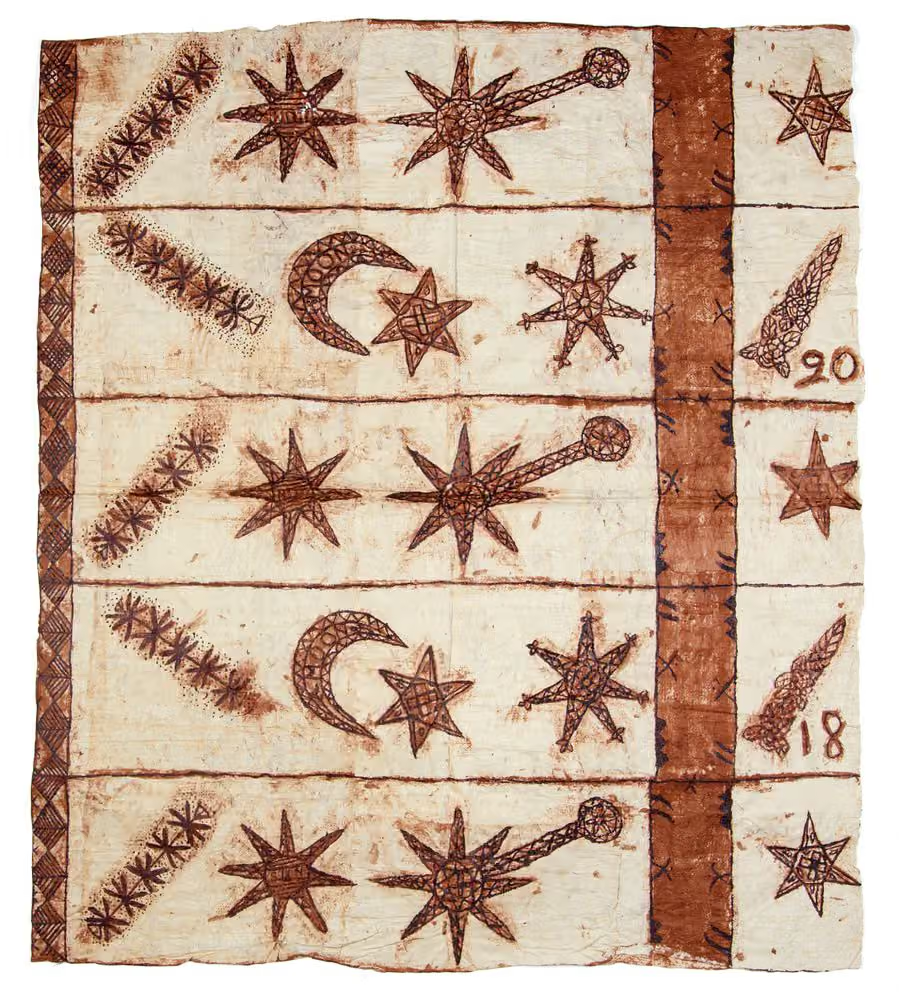
Purchased in 2009. CC BY-NC-ND 4.0. Te Papa (FE012487)
A ngatu dated 1932 bears the name Siaosi Tāufa’āhau, painted beside cricket cups and the crest of Tupou College, where he was then a schoolboy. Decades later, he would become King Tāufa’āhau Tupou IV. His name had already been preserved in bark.
When the Second World War reached the Pacific, it reached Tonga as well. Under Queen Sālote Tupou III, the kingdom raised £15,000 so that Britain could purchase three Spitfires. The first, funded in April 1941, was named after the queen.
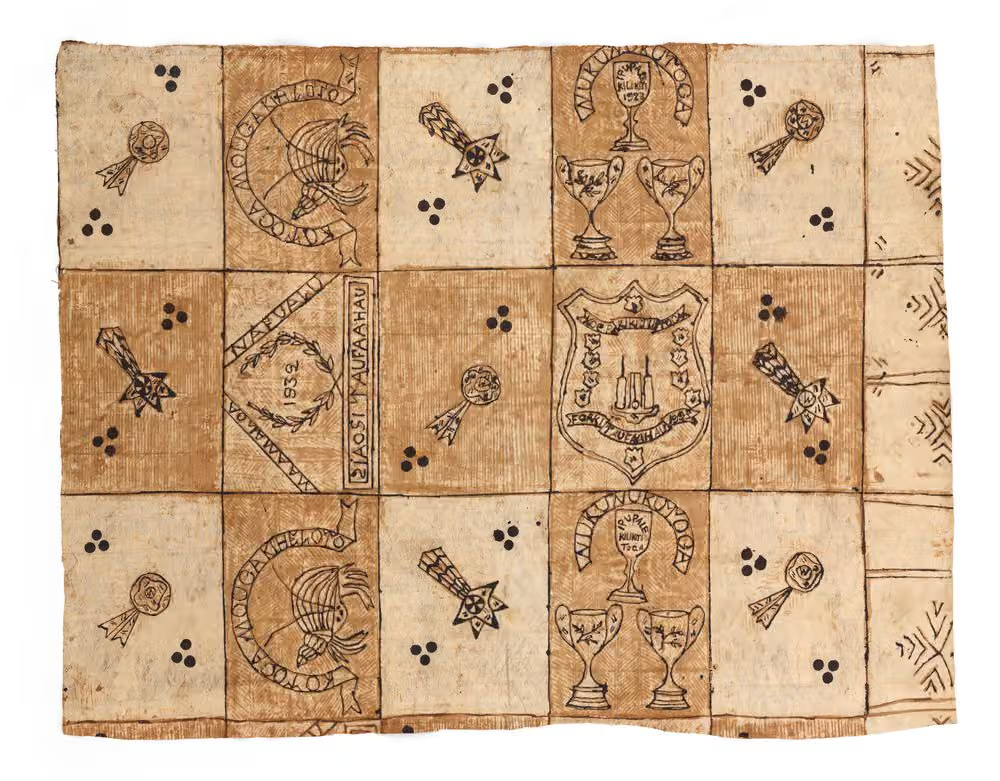
Gift of Valerie Morris, 1989. Te Papa (FE008724).
A ngatu made during the 1940s shows a plane trailing a banner reading Queen Salote, surrounded by the Tongan crest and the flags of Britain and the United States.
A small kingdom had recorded its place in a world war in its own materials, and on its own terms.
What survives at Te Papa is only a fragment, and that too belongs to the story. A number painted near its edge indicates the section of the longer cloth from which it came. Anne Peranteau, the museum’s textile conservator, has explained that ngatu were often cut into smaller pieces so they could be given away.
This was never an archive designed to remain still.
Ngat continues to circulate between families at weddings, funerals, and other important occasions. A cloth made to mark one household’s moment may later become part of another’s.
Because ngatu survives through use, it has also learned to change.
When Tongan women living in New Zealand found it difficult to import bark from home, they began experimenting with other materials. In March 1996, the ‘Ilo Me’a Fo’ou (New Creations) Tongan Women’s Group in Upper Hutt, near Wellington, made a ngatu pepa using Vilene, the synthetic interfacing sold in fabric shops, binding its layers with flour and hot water.
The material was new, but the visual language remained familiar. Dark red, brown, and black were set against an off-white border, echoing the palette of traditional barkcloth. The surface had changed. The knowledge carried through it had not.
In 2021, the group Akomai Heritage brought three generations of Tongan families to Te Papa for a week of public ngatu making. As one of the women told RNZ Pacific, “We are born into ngatu, and we are buried with ngatu.”
For Tonga’s beloved queen, that line was literal.
Sālote, whose name had flown on the first Spitfire, died in New Zealand in 1965, eight years before her kingdom sent its gift to Sydney for Queen Elizabeth II. When her body was flown home, a ngatu some 23 meters long was placed beneath her coffin.
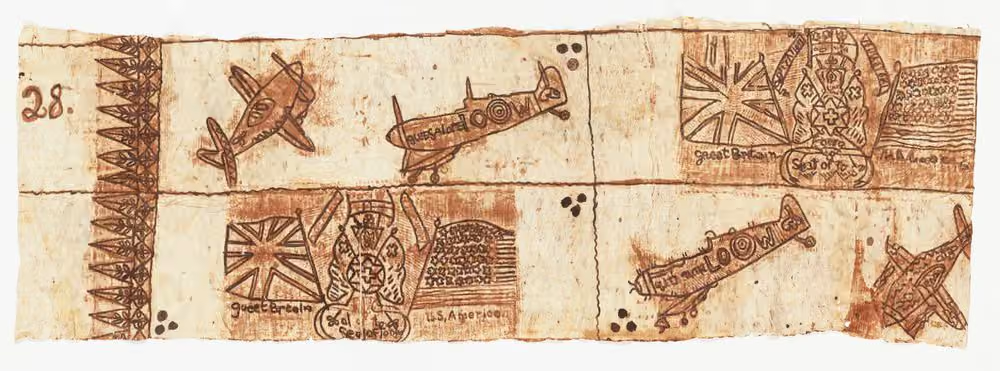
Te Papa (FE012488), Unknown; maker/artist; 1940s; Tonga.
That cloth now rests at Te Papa, in the same collection as the plane.
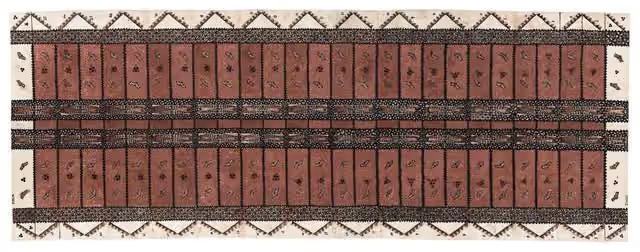
Te Papa (FE010743), Ilo Me’a Fo’ou (New Creations); artist; March 1996; New Zealand.