
By Catherine Jacobi
At Asaba, in Izu, dinner is cleared, and the bed appears while you’re in the bath. That quiet changeover says a great deal about the Japanese way of receiving guests.
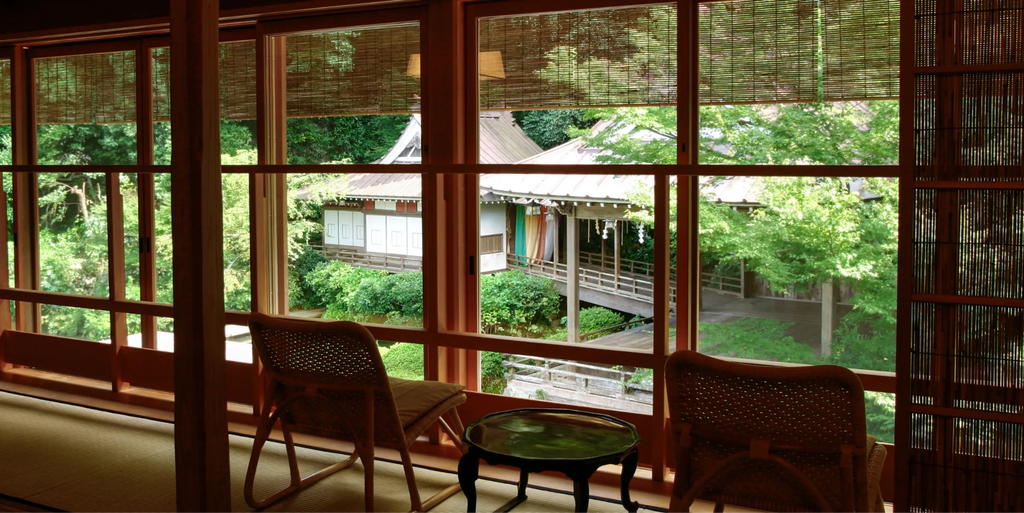
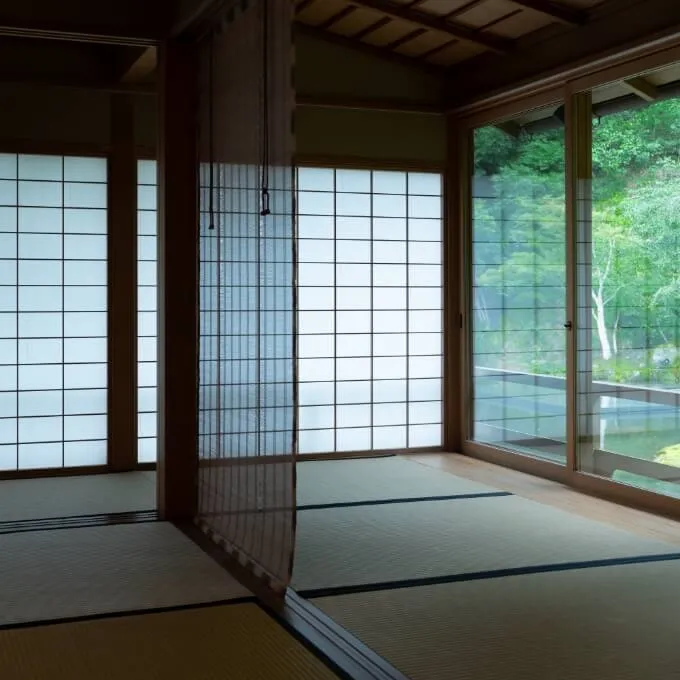
The Japanese style sitting room in Matsukaze, at Asaba, as it looks by day: tatami, a low table and cushions, facing the pond and the Noh stage. Courtesy of Asaba.
At Asaba, in Shuzenji on the Izu Peninsula, shoes stay at the entrance, and guests are shown to their rooms. In Matsukaze, which the house describes as its purely Japanese style room, there is tatami underfoot, a low table in the sitting room, cushions around it, and, beyond the window, the pond and the Noh stage. Tea arrives almost at once. The futon is still put away.
The Japan National Tourism Organization describes the house’s rooms this way: a table and cushions for relaxing by day, thick futons laid over the tatami at night. It is the classic ryokan layout, in which a single room serves as a living room, dining room, and bedroom, one role at a time. At Asaba today, each room has gained a bedroom beside the Japanese-style sitting room, and the changeover now happens across the two spaces, in the same order and at the same hour. The Michelin Guide, which keeps the house among Japan’s Three Key properties, treats Asaba as the prototype of the ryokan, which makes it a good place to watch this changeover happen.
The instinct for hospitality runs deep here. According to the Asaba family, it all began in 1484, when Yakuro Yukitada Asaba became keeper of the Shuzenji temple and opened a lodging for visiting monks in front of its gate. His descendants still run the house today.
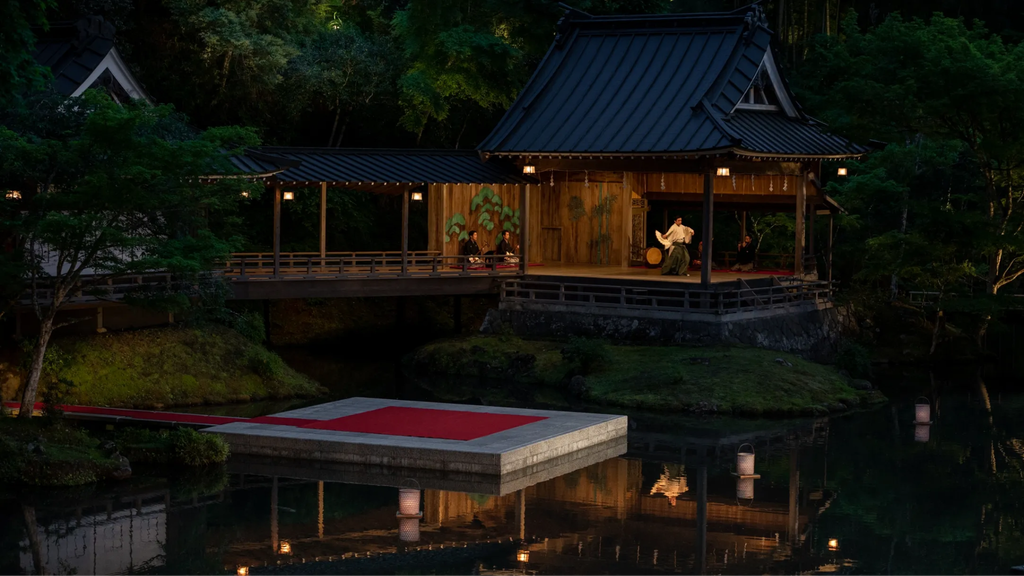
The garden and pond at Asaba, in Shuzenji, on the site where the family opened a lodging for monks in 1484. Courtesy of Asaba.
A day at a ryokan revolves around dinner. Most guests take their first hot spring bath in the late afternoon and return to the room in a yukata. Then the sitting room table receives the meal, served right there between 6 and 7 p.m. by a private attendant. The Japanese have an expression for this kind of care: age-zen sue-zen, setting the table and later clearing it without the guest ever having to ask. The idea goes beyond courtesy. It assumes the house knows its guests’ rhythm well enough to act before any request is made.
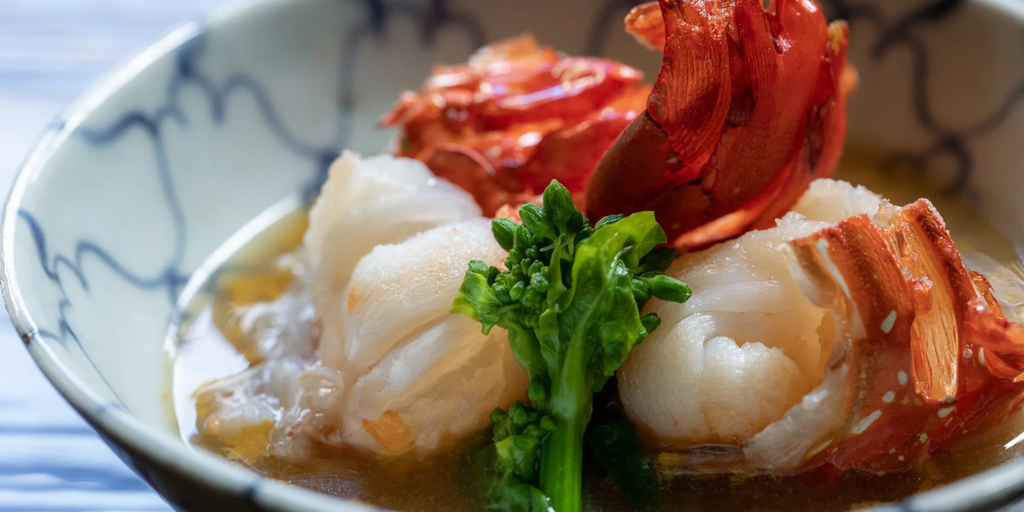
Dinner at Asaba is served in the guest’s room between 6 and 7 p.m. by a private attendant. Courtesy of Asaba.
The custom of bringing the meal to the traveler has its roots on the road. For centuries, anyone crossing Japan carried their own food in a bamboo basket called a hatago and rented only a roof, where they cooked their own food. In the Edo period, when the Tokaido’s stations linked Edo to Kyoto, and travel became common, inns began serving meals and inherited the basket’s name.” Those who stayed without a kitchen became known as kichinyado, because guests paid for firewood and fended for themselves. From this shift comes the rule that still organizes the ryokan: one night, two meals, dinner and breakfast.
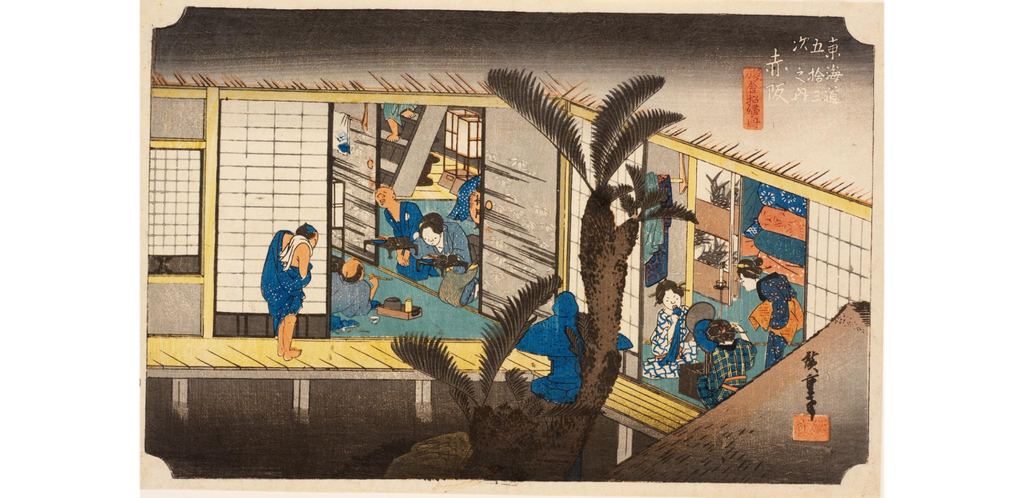
Utagawa Hiroshige, “Inn with Serving Maids, Akasaka,” no. 37 from the series The Fifty-three Stations of the Tokaido, c. 1833–1834. Color woodblock print, published by Takenouchi Magohachi (Hōeidō). RISD Museum, gift of Mrs. John D. Rockefeller Jr. (41.080.37). Public domain.
The room can change roles only because it was designed to. During the Edo period, tatami came to cover entire floors, and the Japanese bed, the futon, never had a fixed frame. In the morning, it is folded and stored in the oshiire, a deep closet with sliding doors, and the room becomes a living space again. The ryokan carried this domestic logic into hospitality, with one decisive difference: at home, everyone lays out their own bed; at a ryokan, someone does it for you.
The changeover happens in the interval. Once dinner is over, while the guest returns to the hot spring or strolls through the garden, the attendant clears the dishes and lays out the futon, with sheets and a duvet, over the tatami. Asaba guests describe exactly this: after dinner, the futon appears, ready. The timing varies from house to house, and the contrast helps explain the concept. At minshuku, the simpler family-run guesthouses, the futon waits in the closet, and guests lay it out themselves. At a ryokan, age-zen sue-zen extends to the whole room: after the table, it is the room itself that changes without anyone having to ask.
The futon laid out on the tatami of the bedroom after dinner, in one of Asaba’s traditional rooms. Courtesy of Asaba.
Asaba has adapted to today’s traveler. Six of its rooms have custom-made queen beds, with futons brought out when more than two people stay. In the others, such as Matsukaze, the bed is still a custom-made futon laid out after dinner, facing the Noh stage the family brought from Tokyo in the late Meiji period.
More than five centuries after Yakuro Asaba opened his doors to the monks of Shuzenji, the scene remains the same. You come back from the bath, the dishes have been cleared, and the futon is waiting on the tatami, laid out by someone you never saw come in.
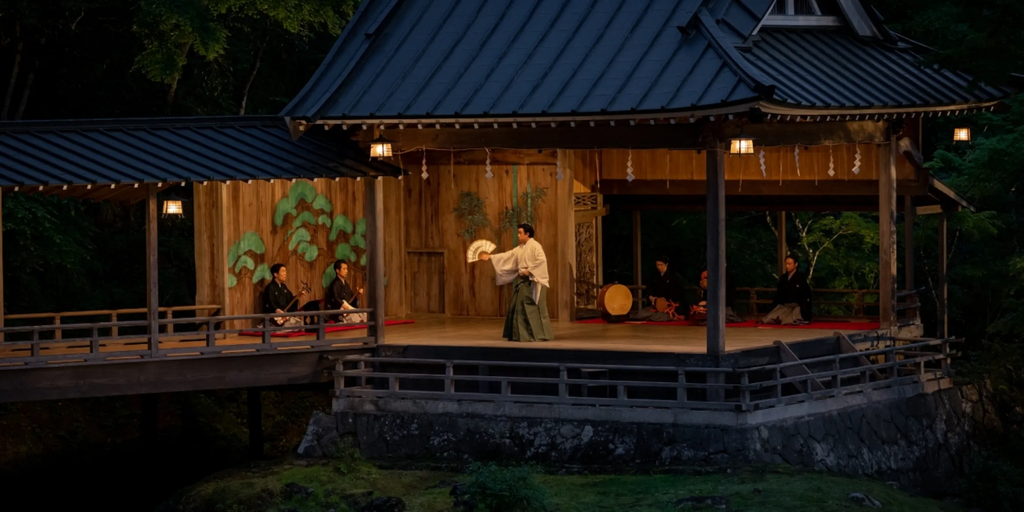
The Gekkeiden, Asaba’s Noh stage, brought from Tokyo in the late Meiji period and set across the pond from the guest rooms. Courtesy of Asaba.