
By Catherine Jacobi
It began as a way to imitate costly stone. Within a century, Grand Tourists were waiting years for tables made of it by a monk in the Tuscan hills.
In the British Museum‘s Enlightenment gallery, the room Robert Smirke designed in the 1820s to hold George III’s library, the walls glow in shades of polished stone. The museum’s own guide lists what lines them: granite, marble, and scagliola, in several colors. Most visitors walk past without a second glance, certain they are surrounded by stone. The third material is plaster. Its veins run as deep and its surface shines as coolly as the granite beside it. Michael Koumbouzis, a British scagliolist who has been restoring it in historic houses since 1983, writes that well-made scagliola looks and feels just like the marble it imitates, only a little warmer to the touch. Pronounced skal-YOH-la, with a silent g, scagliola has been passing for stone in grand interiors since the seventeenth century. The more interesting story is what happened next.
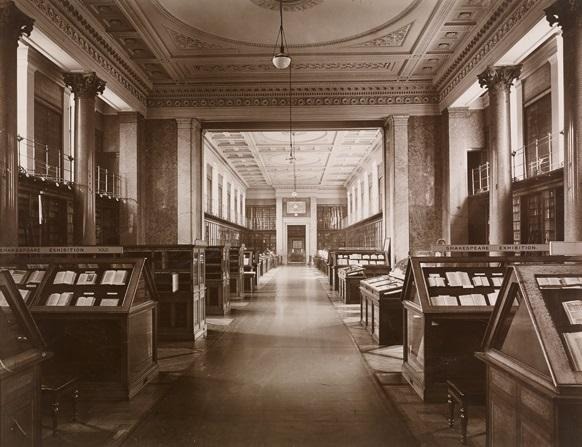
The King’s Library, now the Enlightenment Gallery. British Museum.
The story begins with selenite, a translucent gypsum from the Apennines that Italians call pietra di luna, moonstone. Artisans grind it to a powder and mix it with glue and natural pigments into a colored paste. They press the paste into hollows carved in a slab, following a drawing, then polish the dried surface to a gleam. Because the color runs through the material instead of sitting on top, it can be sanded and polished like stone, unlike faux marbre, a painted effect, cannot. And because every color is mixed by hand, it also escapes a limitation inherent to pietra dura, the Florentine art of cutting real stones and fitting them together, where the palette depends on what the quarry provides.
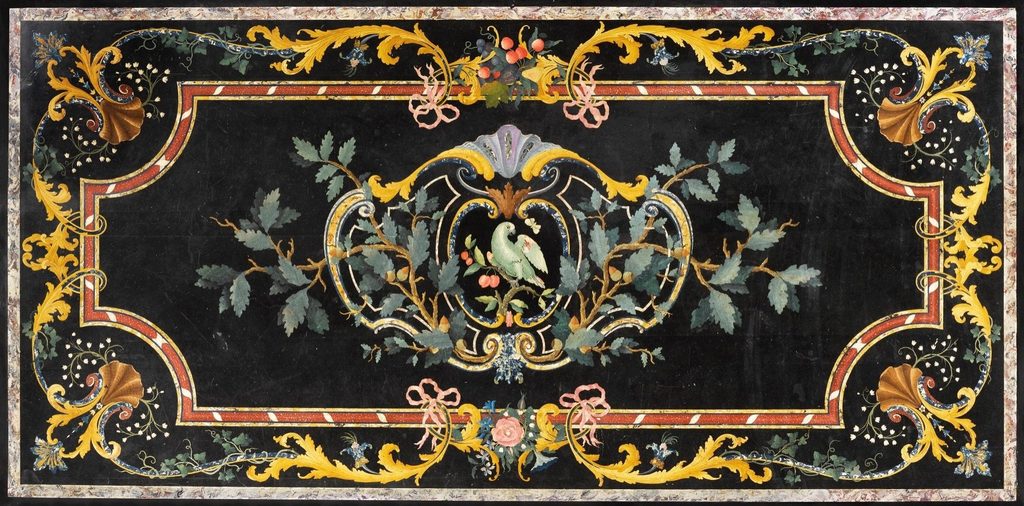
Italian scagliola top, second half of the 18th century
Scagliola took shape in the early seventeenth century in Carpi, near Modena, where its invention is credited to the architect Guido Fassi (1584–1649). The town’s churches still hold its altar frontals. Itinerant craftsmen soon carried the recipe north, and one of the pieces they left behind shows the material already slipping its brief. The Victoria and Albert Museum holds a table made around 1671, probably in England and attributed to the Italian Baldassare Artima. Its legs do what scagliola was invented to do, imitating Siena marble. Its top does something else. A crown imperial flower rises from a Persian vase, cornucopias spill lemons and tomatoes, and birds and butterflies settle on a glossy black ground. No quarry could supply that palette, and the museum notes that the colors have stayed bright, unlike those of the wooden marquetry tables of the same form. On one table, the legs still imitate while the top has begun to invent.
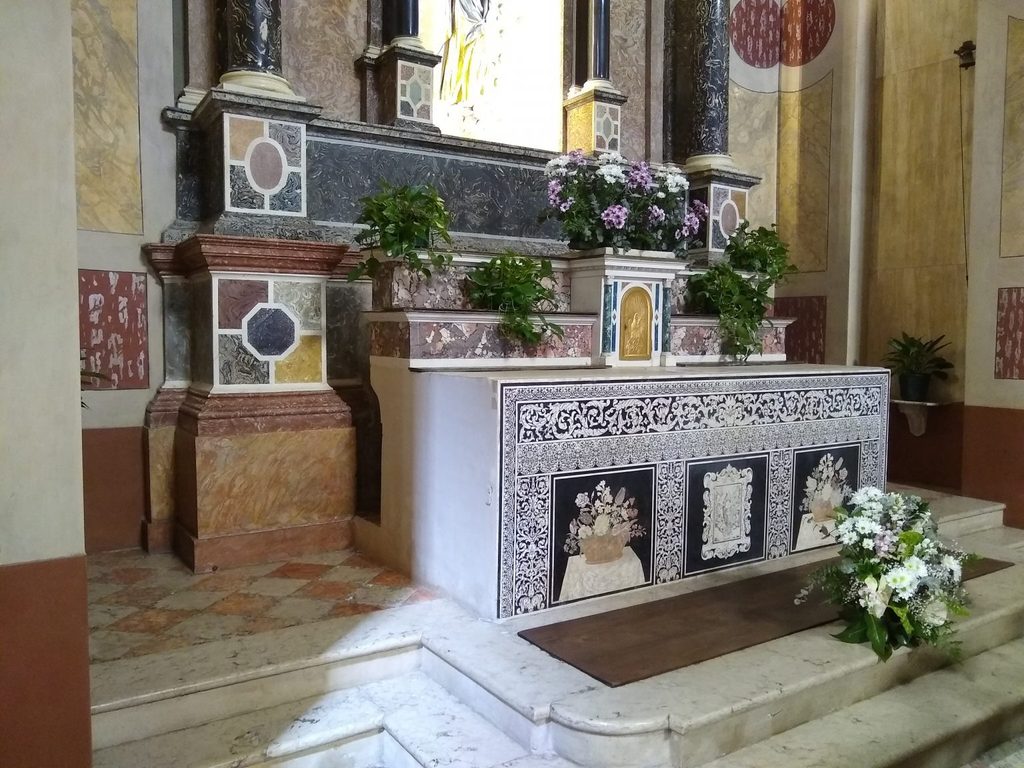
Scagliola panels imitating coloured marbles by Guido Fassi in the chapel of the Assumption, Carpi Cathedral, 1629. (Altar front by Giovanni Gavignani, 1670s).
In Tuscany, that invention found its master. Enrico Hugford, a Florentine born to English parents in 1695, learned scagliola as a Vallombrosan monk near the selenite quarries of Marradi. He spent the rest of his life turning it into another form of painting. From Vallombrosa came seascapes, harbors, vases of flowers, and scenes from monastic life, pictures that had no reason to pretend to be stone. English collectors on the Grand Tour waited for them. In 1741, the slab under a table ordered by Horace Walpole split just as Hugford was finishing it. The diplomat Horace Mann begged the monk to start over, and later reported that other English buyers had offered more than Walpole’s price for the result. The priests who made these tables, Mann wrote, “work for diversion and won’t be hurried.”
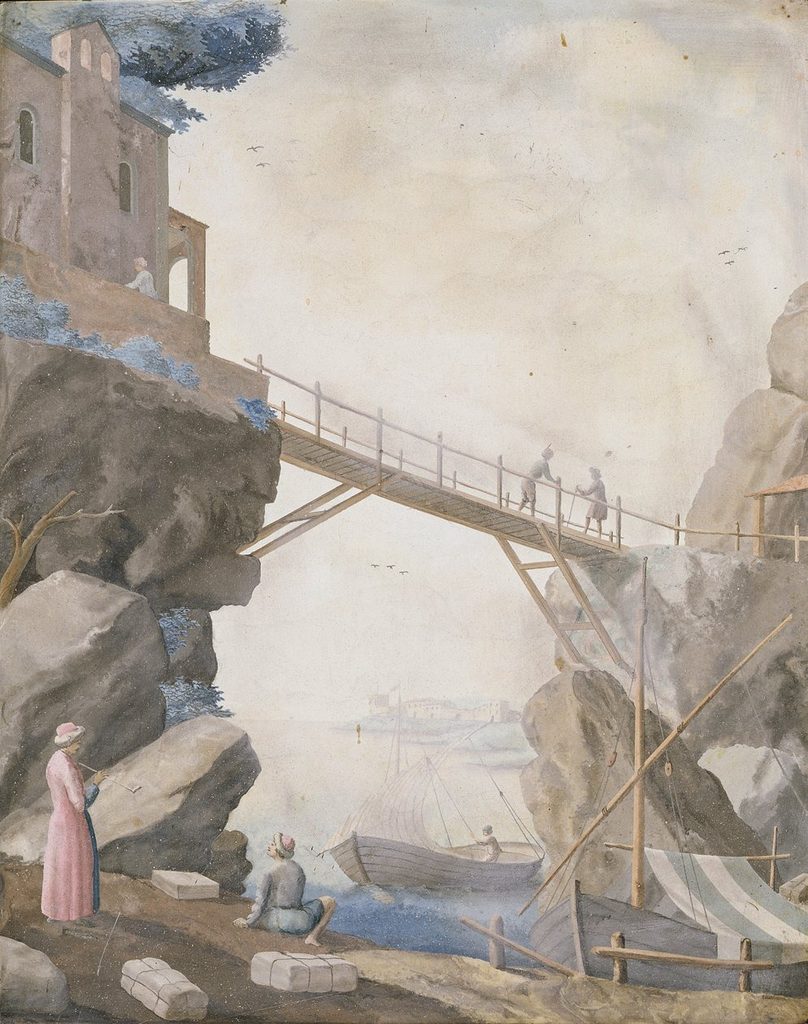
Scagliola Panel by Ferdinand “Enrico” Hugford.
Hugford’s reputation outlived him. Eight years later, the grand duke of Tuscany acquired four of his landscapes from the heirs of his brother, the painter Ignazio Hugford. Two of them now belong to the museum of the Opificio delle Pietre Dure, the workshop the Medici founded to cut precious stone. The house of real stone had made room for the substitute.
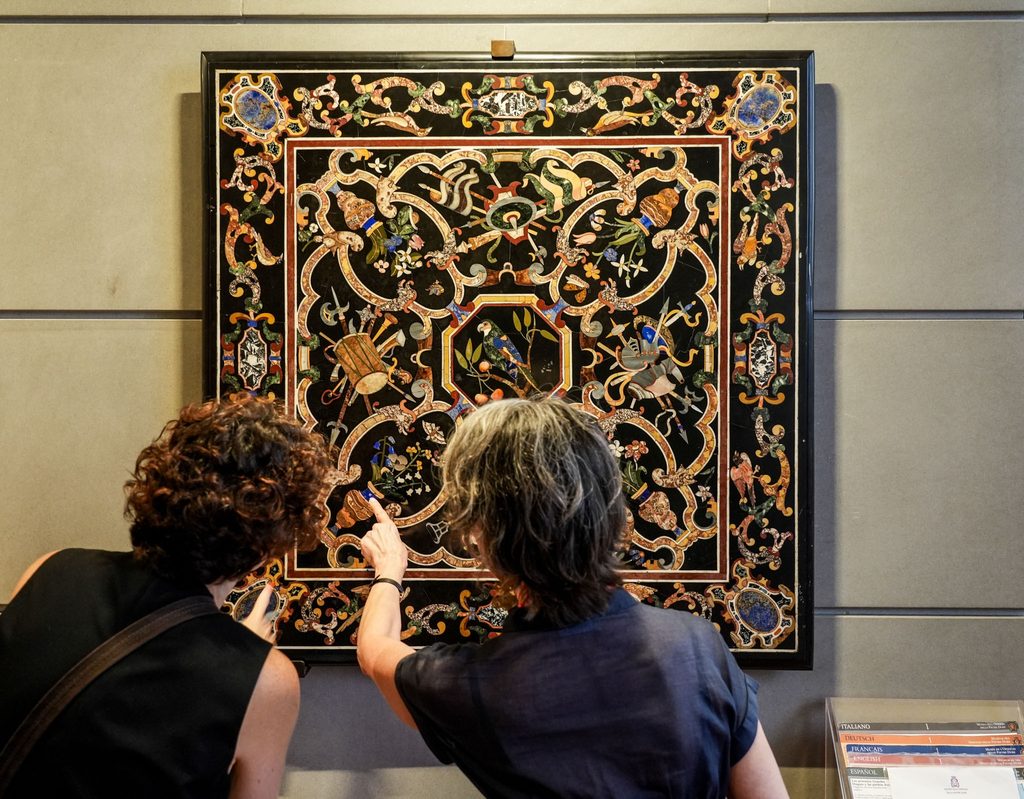
Photo by Marco Badiani. Courtesy of the Opificio delle Pietre Dure.
By the mid‑nineteenth century, the workshops had begun to close; cement and mass production did the rest, and the recipes went with them. It took a clerk at Italy’s Ministry of Defense to bring them back. In the late 1940s, Bianco Bianchi (1920–2006) fell for the scagliola tables at the Opificio museum. He spent about ten years at his kitchen table, testing mixtures until the old results reappeared. His children, Alessandro and Elisabetta, and now his grandson Leonardo, still work entirely by hand in Pontassieve, outside Florence. The process is slower and more physical than the finished surface suggests. Designs are cut with small, heavy chisels that can slip at any moment, the paste goes in soft and wet, and its colors dry paler than they were mixed. A single fill can take two hours to set in summer and eight in winter. In 2025, the V&A filmed the family recreating part of the Warwick Castle table by hand, more than three centuries after the original.
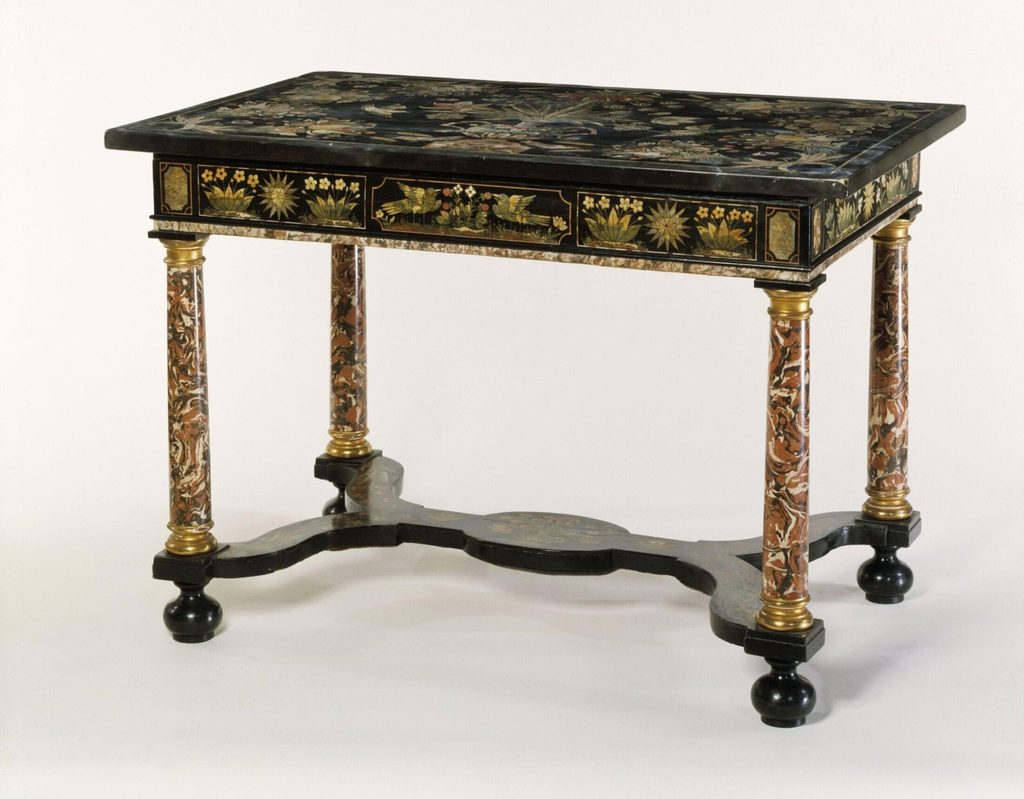
The Warwick Castle table, 1671. Baldassare Artima, Diacinto Cawcy. Courtesy of V&A Museum.
Their commissions show how far scagliola has moved from its original purpose. They include a Medusa table for Gianni Versace, a crested tabletop now at Kensington Palace, and a panel based on Gucci’s Flora, the scarf print drawn in 1966 for Grace Kelly. The Houston Museum of Natural Science bought the Flora panel in 2018. That museum keeps more than 750 mineral specimens in its hall of gems, each one bound to the colors the earth gave it. The Flora panel, made of the same humble paste that lines George III’s library, shows a garden no quarry could yield. In London, scagliola was chosen to pass for stone. In Houston, it was chosen for what stone cannot do. That is how an imitation became an object of desire.
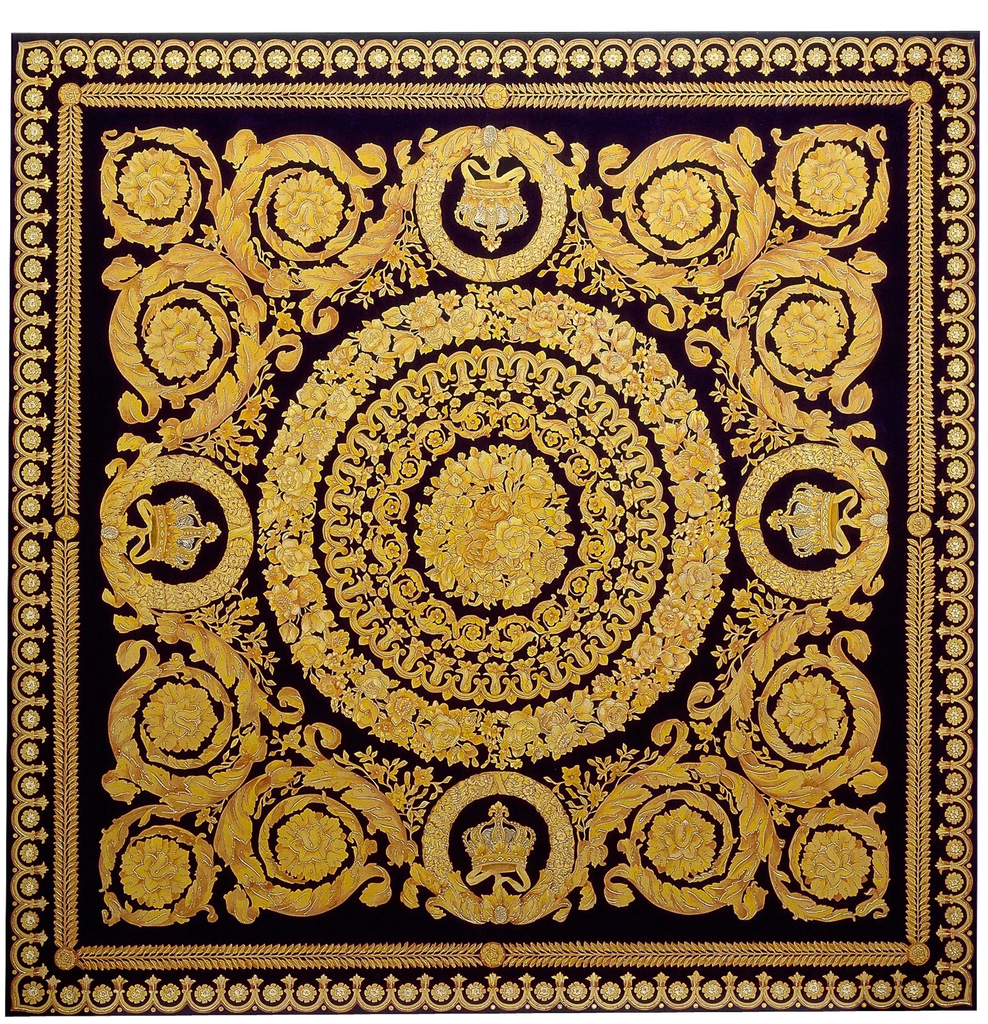
“Barocco” table, created for Gianni Versace, 1987. Bianco Bianchi.