
By Catherine Jacobi
The photographer behind Vogue’s most famous corset also designed his own house, planted his own garden and spent decades in other people’s drawing rooms, looking at each of them with the same exacting eye.
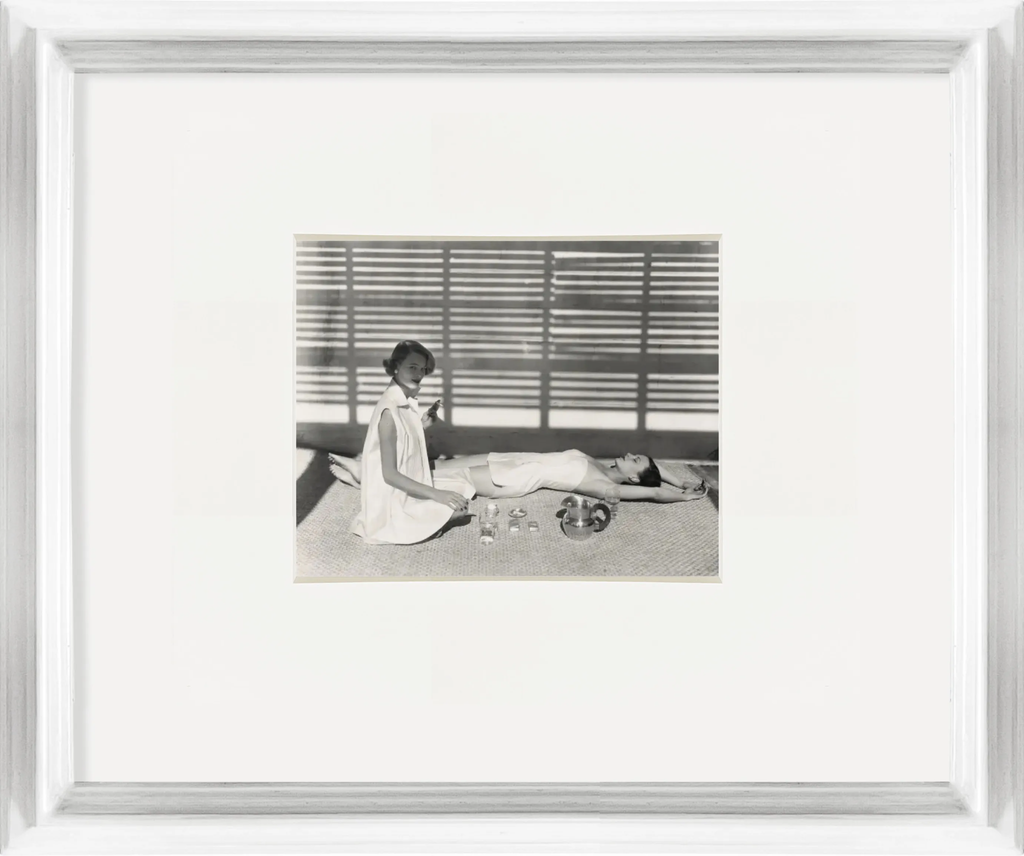
Summer fashion at Horst’s house, Oyster Bay, 1948. Horst P. Horst for Vogue. © Condé Nast / Horst Estate.
In 1947, among the first guests to arrive at Horst P. Horst’s new house in Oyster Bay Cove were Noël Coward, Christopher Isherwood, Greta Garbo and a British diplomat named Valentine Lawford, who would share Horst’s life for more than four decades. The house was low and white, finished in stucco, and Horst had drawn it himself, taking inspiration from houses he remembered seeing in Tunisia. The land, five acres on Long Island’s North Shore that had once belonged to Louis Comfort Tiffany’s estate, was, in his words, everything he had ever dreamed of.
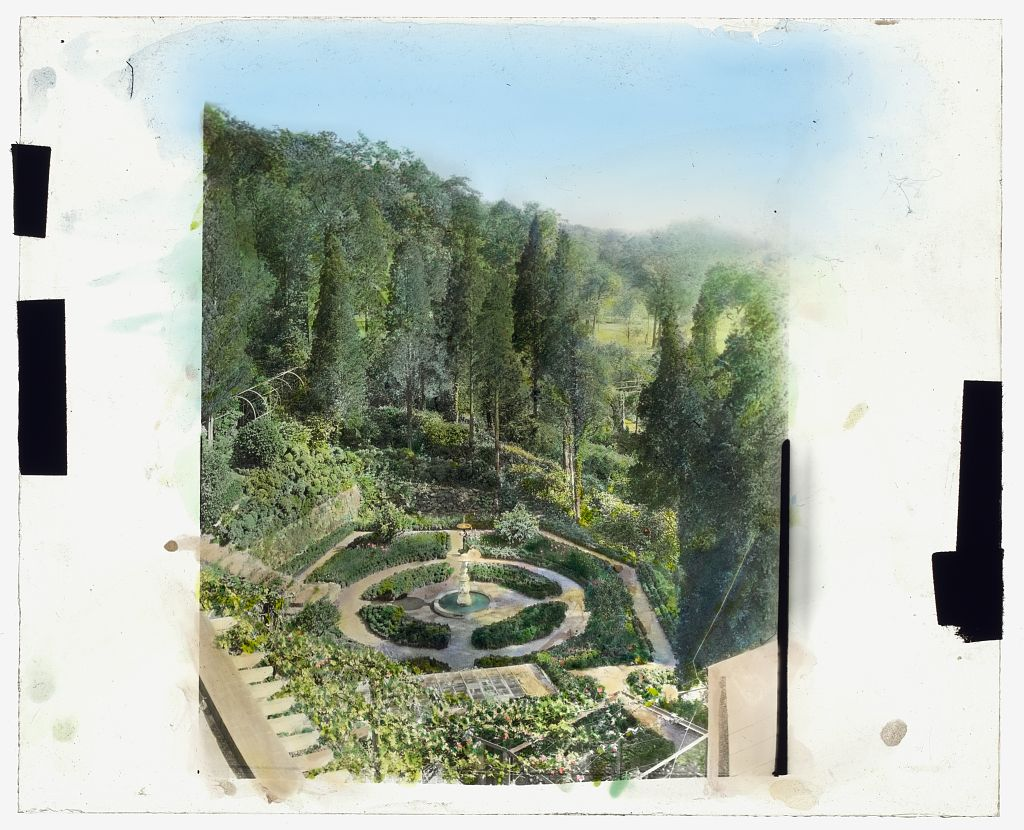
Laurelton Hall, Louis Comfort Tiffany’s estate, Laurel Hollow, New York, early twentieth century. Archival photograph, Library of Congress Prints and Photographs Division.
The house was barely finished when Vogue’s art director, Alexander Liberman, decided it was already ready to be photographed. The first images made there were fashion pictures: bathing suits and summer dresses arranged in the sun on straw mats. From its first summer, the house was both home and set, and Horst seemed entirely at ease with the idea that it could be both.
That instinct, to move effortlessly between inhabiting a room and composing one, had deep roots. Born Horst Paul Albert Bohrmann in 1906, in a small town in eastern Germany, he studied applied arts and carpentry in Hamburg before moving to Paris in 1930, hoping to work for Le Corbusier. Architecture lost him almost immediately. He met George Hoyningen-Huene, the star photographer of French Vogue, became his assistant, model, and lover, and within a few years had taken his place as Paris Vogue’s principal photographer.
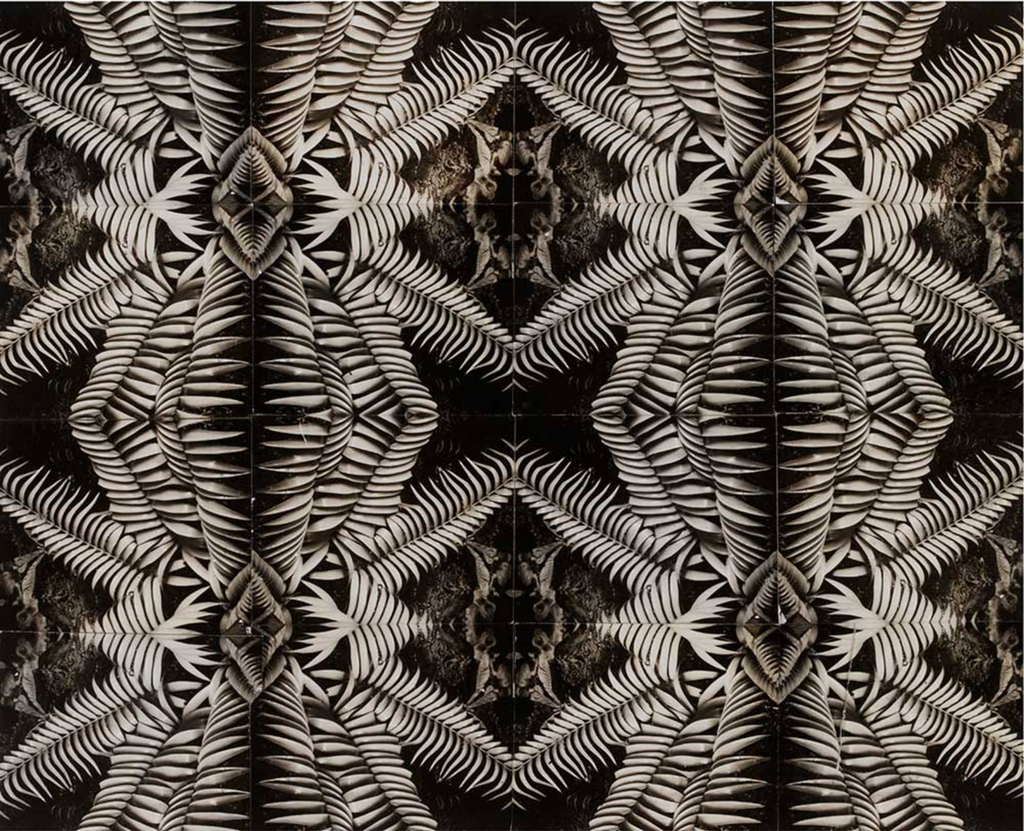
Patterns from Nature, photographic collage, about 1945. Horst P. Horst. © Condé Nast / Horst Estate, via the V&A.
But Horst never really stopped building. His couture photographs of the 1930s, made for Chanel, Vionnet and Schiaparelli, unfold among columns, plinths and expanses of plaster. His estate traces his lifelong sense of structure and proportion back to those years in Hamburg. Once you know about carpentry, you begin to see it in every frame.
His most famous photograph sits precisely at the turning point of his life. In August 1939, in Vogue’s Paris studio, Horst photographed a model from behind wearing a pink satin corset made by Detolle for Mainbocher, though its color disappears for anyone who knows the image only through the black-and-white print. He worked into the small hours, collected his bags, and took an early train to Le Havre, where he boarded the Normandie for New York.
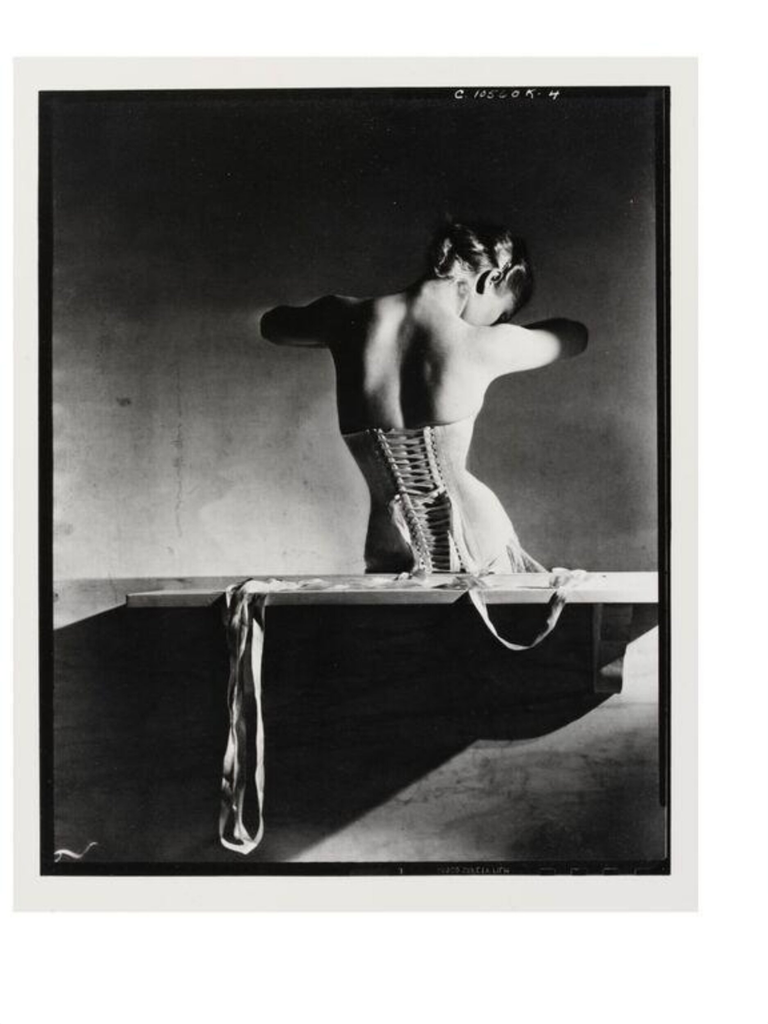
Mainbocher Corset, Paris, 1939. Horst P. Horst for Vogue; corset by Detolle for Mainbocher. First published in American Vogue, September 15, 1939. © Condé Nast / Horst Estate.
While making the photograph, he later recalled, “I was thinking of all that I was leaving behind.”
Much of what followed feels like an answer to that night. In America, Horst began assembling, piece by piece, a world he wanted to inhabit. In 1943, when he joined the US Army and became an American citizen, he even gave himself a new name within it: Horst P. Horst.
Part of that world he found growing. After the war, he stepped away from couture for a time and turned his camera toward shells, plants, and minerals, photographing them at such close range that familiar forms became strange. The studies became the 1946 book Patterns from Nature. Horst remarked on the way vegetal forms echoed wrought iron and Gothic architecture, a comparison that reveals much about the way he regarded a garden: not simply as landscape, but as structure, with its own columns, patterns and tracery.
At Oyster Bay, he and Lawford shaped a garden around the house. His estate would later be described as both their private retreat and one of Horst’s recurring subjects.
Travel fed the same curiosity, now directed toward the ways other people arranged their lives. Lawford was posted to the British Embassy in Tehran, and in the summer of 1949, the two drove from Beirut to Persepolis, where Horst photographed parts of the ancient Persian city that had only recently been uncovered. The following spring, they spent ten days as guests of Malik Mansur Khan Qashqa’i, accompanying his tribe by camel and horseback during its seasonal migration in search of pasture.
Within the space of a year, Horst had photographed both a palace that had outlived its kings and a household designed to pack itself up and follow the grass.
The person who understood how naturally these worlds belonged together was a regular guest at Oyster Bay. When Diana Vreeland arrived at Vogue in 1962, she put Horst and Lawford to work on Fashions in Living, pages devoted to the homes of people whose taste she considered worth documenting. Lawford wrote and Horst photographed, with subjects ranging from the Duke and Duchess of Windsor and Gloria Guinness to Yves Saint Laurent and Andy Warhol.
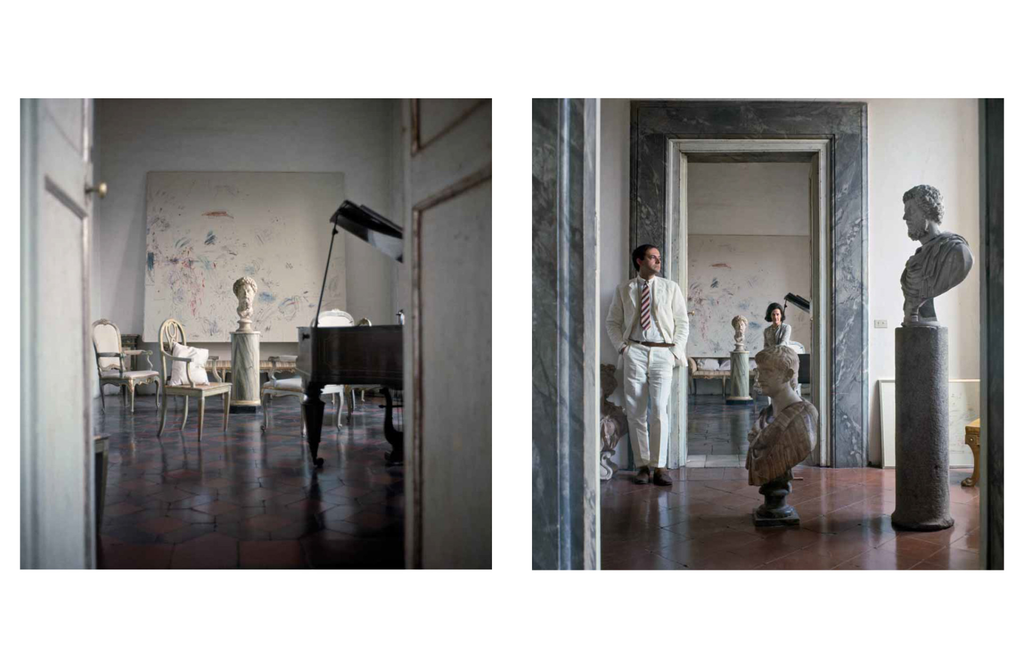
Cy Twombly at home in Rome, 1966. Horst P. Horst for Vogue (published as “Roman Classic Surprise”). © Condé Nast / Horst Estate.
Horst worked as a perceptive houseguest might. He often stayed for days, occasionally for as long as two weeks, allowing time to understand a house, its inhabitants, and its light. In Rome in 1966, he photographed Cy Twombly and his wife, the painter Tatiana Franchetti, moving through the rooms of their seventeenth-century palazzo, leaving the furniture exactly where they had placed it.
At times, a single object could hold an entire portrait. Philippe de Rothschild’s embroidered slipper, resting on a carpet woven with the face of Napoleon III, said as much about its owner as a formal sitting might have done.
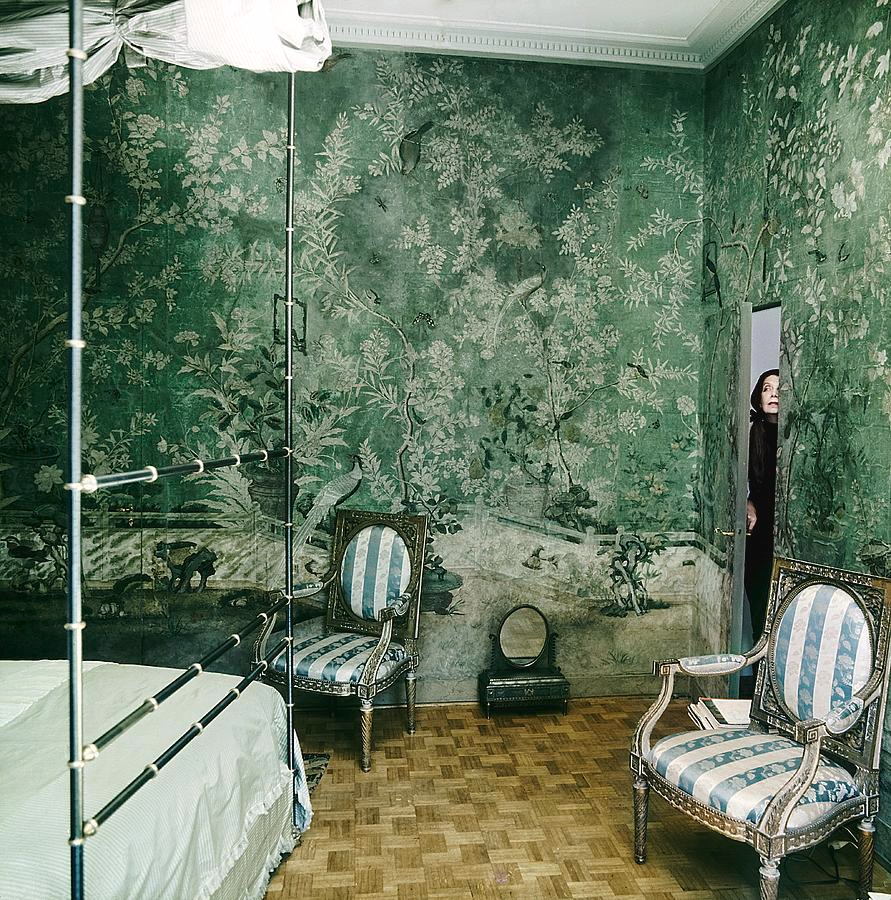
Baroness Pauline de Rothschild at her apartment in Paris, 1969. Horst P. Horst for Vogue. © Condé Nast / Horst Estate, via the V&A.
Eighteen of these houses were gathered in Vogue’s Book of Houses, Gardens, People in 1968. Seen beside Horst’s earlier studio work in Paris, the photographs reveal the same instinct operating in reverse. Where he had once constructed a room around a dress, he was now entering rooms that people had constructed around themselves. It was, in many ways, precisely what he had done on Long Island.
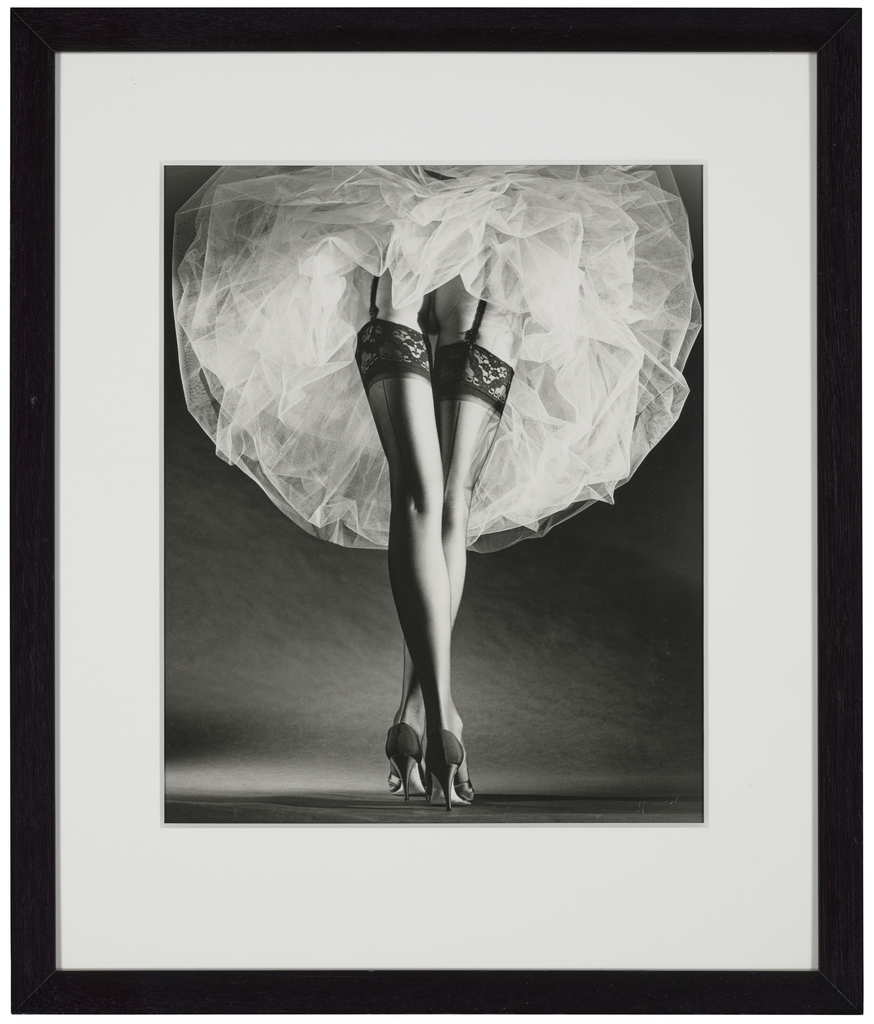
Round the Clock, New York, 1987. Horst P. Horst. © Condé Nast / Horst Estate, via the V&A.
Horst stopped working in 1992, when his eyesight began to fail, and died in Florida in 1999, at the age of 93. During his final working decade, he revisited negatives from every period of his career and had the images he cared about reprinted in platinum and palladium, a slow and costly process using metals more precious than gold.
The corset was among them.
On the reverse of one of those prints, later sold at Christie’s, the pencil notes recording the printing and edition are in the hand of R.J. Horst, the son he and Lawford raised in the white house on Long Island.