
Between British tradition and life on Harbour Island, India Hicks turns home, objects, memory and hospitality into a deeply personal way of living.
After living across countries and cultures, it was on Harbour Island, in the Bahamas, that India Hicks came to understand the difference between inhabiting a beautiful place and truly feeling at home. The daughter of designer David Hicks, she grew up in a world where interiors, porcelain, textiles, books and rituals around the table were taken seriously. In the Caribbean, that British heritage met open doors, bare feet, meals outdoors, and a more relaxed relationship with everything that cannot be controlled.
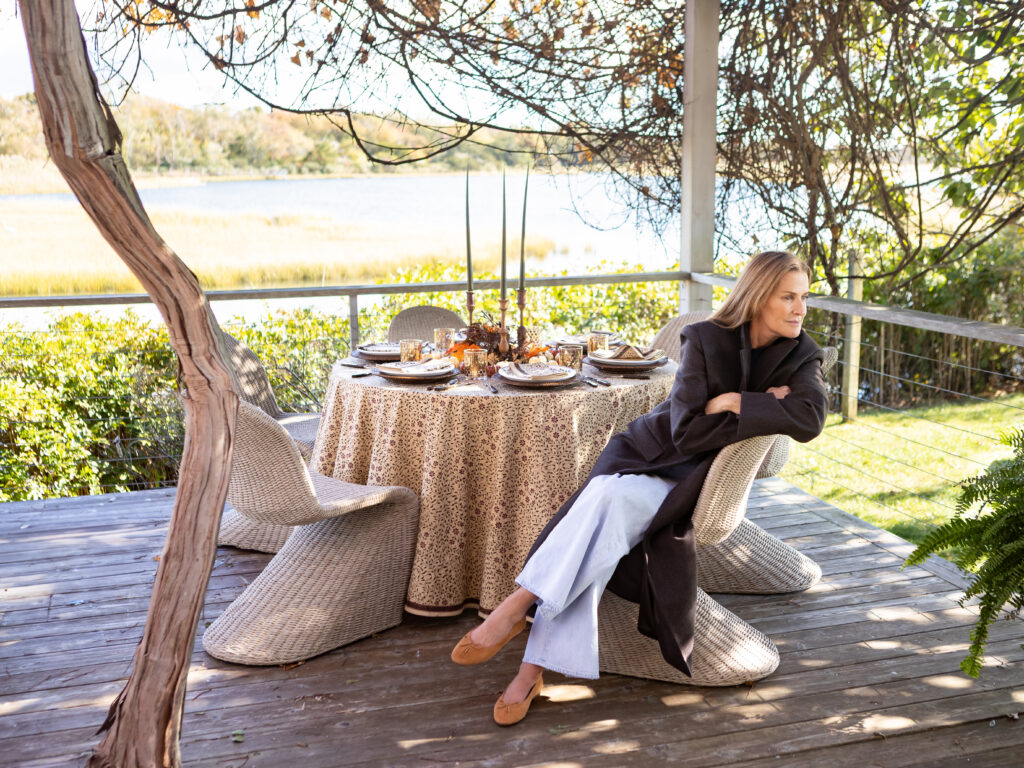
In her home, inherited pieces coexist with photographs, books, textiles and mementos from her travels. Time, too, becomes part of the decoration: the sun bleaches whatever it touches, salt corrodes, wood changes, and signs of wear become part of the story. This idea of beauty lies at the heart of her new book, Entertaining with a Side of Chaos, in which hospitality has less to do with performance and more with the willingness to open the door.
LM: Your life has always been deeply connected to the idea of “home,” yet you’ve lived across different countries and cultures. Today, what does home mean to you beyond a physical place?
IH: I’ve lived in enough places to know that you can have a very beautiful house and still not feel at home in it. And equally, you can be sitting on a slightly broken chair, eating something rather questionable, surrounded by people you love, and think: yes, I am home
LM: What are the little details in your home that guests often notice or comment on?
IH: Usually the things I have stopped noticing altogether — piles of books, family photographs, dogs occupying furniture they have absolutely not been invited onto, and objects collected over many years that don’t necessarily belong together but have somehow learned to get along. There is very little that is precious, in our home here on Harbour Island If something cannot survive a child, a dog, a drink being put down without a coaster, or a slightly overenthusiastic houseguest, it probably shouldn’t live with us.
LM: Many people strive for beautifully decorated homes, but yours always seem to feel genuinely lived in. What do you think gives a house its soul?
IH: Layers. And time. A room becomes interesting when things have happened in it. When somebody has cried on the sofa, fallen asleep in the chair, danced in the kitchen, burnt the dinner, brought home a ridiculous souvenir and insisted it be displayed. Most recently we returned from the FIFA World Cup in Miami with a miniature golden World Cup football, which has somehow taken up residence in our entrance hall. As though what our house was really missing was a miniature golden football.
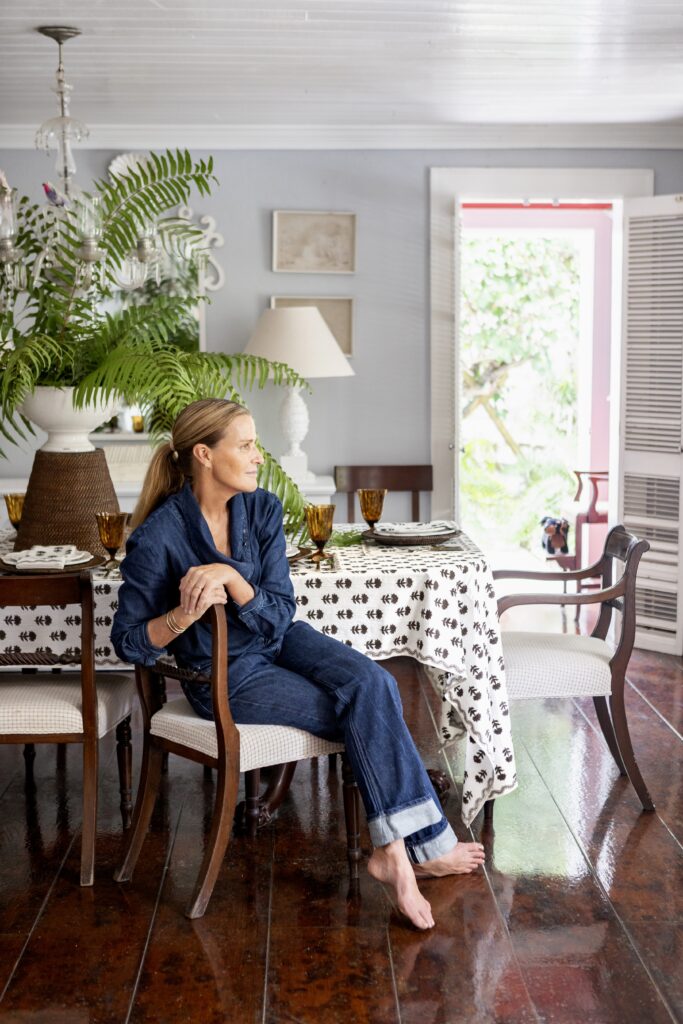
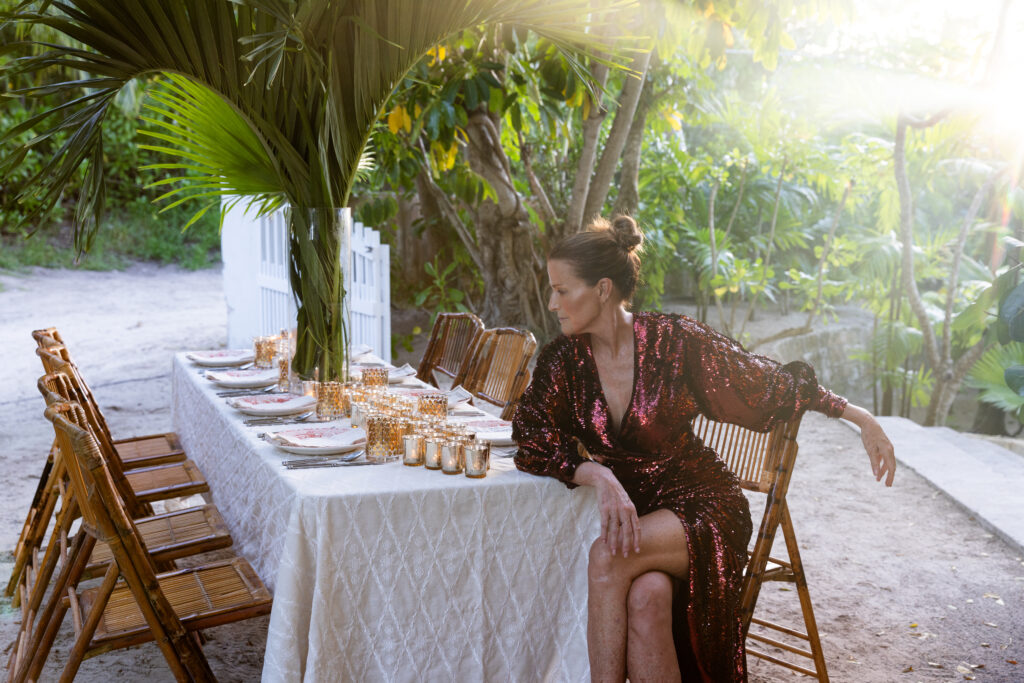
LM: Harbour Island has become inseparable from your identity. In what ways has island life reshaped your daily rituals, priorities, and sense of beauty?
IH: Island life has taught me that nature is the better decorator. The light changes constantly. Salt ruins almost everything. Sand gets everywhere. Plants grow where you didn’t ask them to. Things fade, rust, crack and weather and somehow become more beautiful because of it. Living here makes you understand that a good day can be incredibly simple: an early swim, bare feet, dogs, family, friends appearing unexpectedly, supper outside. And perhaps a rum drink at an hour one would struggle to defend in London. Don’t be fooled though, by the palm trees and cocktails — island life still comes with office hours, deadlines and a great deal more hard work than the postcards let on.
LM: You often celebrate entertaining without chasing perfection. Why do you think we’ve become so afraid of welcoming people into imperfect homes?
IH: We have all somehow come to believe the house must be immaculate, the flowers magnificent, and the food impressive. That’s nonsense. Years ago, a rather high-profile actress was visiting Harbour Island and reached out to us, we invited her and her boyfriend for supper on Thursday. Except somehow messages got crossed. On Wednesday evening, we were sitting down in front of the television with boiled eggs and soldiers when the dogs suddenly went berserk at the front door. There stood this sensational actress and her boyfriend. Dressed for dinner. Boiled eggs and soldiers became supper for four remarkably quickly. Would I rather have had the table beautifully laid, candles lit, music playing and something delicious cooking away in the kitchen? Of course. But would I remember that evening nearly as well? Absolutely not.
LM: When guests leave your table, what do you hope they remember most: the food, the setting, the conversations, or something else entirely?
IH: How they felt. I hope they felt welcomed, included and reluctant to leave.
LM: What is the one corner of your home that feels the most “you”?
IH: My bedroom. It is my peaceful haven, never more so than now because my bed is made up in the new bedding collection I’ve designed for Pomegranate Inc., hand-block printed in India. I love a properly made bed. Possibly to an unreasonable degree. And this bedding makes that wonderfully easy. One good pull of the cover, turn down the reversible top, and suddenly its done. And because it’s my design, on my bed, in my room, it probably is the corner of the house that feels most completely me.
LM: Having grown up in Britain and built your life in the Bahamas, how do those two worlds continue to shape your everyday rituals and sense of home?
IH: Britain gave me a love of ritual: inherited china, books, fires, muddy walks, slightly gloomy weather (Tina Brown once wrote about us Brits that she could hear “the rain in their voices.”) I love rain! And the deeply British belief that almost any emotional crisis can be improved by putting the kettle on. The Bahamas taught me informality. Open doors, bare feet, brilliant colour, eating outside, living closer to nature and understanding that not everything needs to be planned within an inch of its life. I suppose my home is a muddle of the two.
LM: Travel has always been part of your story. Have you ever discovered a place that quietly changed the way you think about living or about home itself?
IH: What travel has taught me, more than any single place, is how little we actually need. You can find immense beauty in very humble rooms and complete soullessness in extremely expensive ones. The places that stay with me tend to be those where life spills out. Santa Teresa in Costa Rica is one of those places. It’s a wonderfully relaxed surfing community where everyone hurtles around on quad bikes wearing very little except for skiing goggles against the extraordinary dust — all very Mad Max. And almost everyone seems to have a dog balanced somewhere between the seat and the handlebars, or perched on the back. Stretch now rides around Harbour Island with me on my quad bike. He balances extremely well.

LM: What is one thing you’re always collecting, whether intentionally or not?
IH: I appear to have inadvertently started collecting table linens. Apparently designing and making them for Pomegranate wasn’t enough; I now bring them home from around the world as well. Recently I was given a beautiful table runner and napkins from Ukraine. I’ve visited Ukraine often, under terribly difficult circumstances, so those pieces inevitably carry far more for me than just their pattern. They bring back memories of the country, the people and particular moments I don’t want to forget.
LM: Books seem to play a meaningful role in your world. Which book has stayed with you the longest, not because you’ve read it the most, but because it continues to shape the way you see life?
IH: Books play a meaningful role in my world because I’ve always been surrounded by people who read voraciously. My mother was an avid reader and David is an extraordinarily avid one. Our house is overflowing with books. David’s knowledge, depth of interest and curiosity are so wide and varied that I started posting David Flintwood’s Book Club on Substack. I thought if I’m benefiting from having this walking library in the house, other people might as well.
LM: What does a perfectly ordinary Sunday at home look like for you?
IH: Sunday was always anchored by lunch with my mother. It was completely non-negotiable. If I was in England, I would be there in person with her and my brother. If I was in the Bahamas, I would join them on FaceTime, usually eating my breakfast while they ate Sunday lunch. Different countries, different meals, same table really. It was such an ordinary ritual that I don’t think I understood at the time quite how precious it was. I do now.
LM: Your new book, Entertaining with a Side of Chaos, embraces the beauty of imperfection. Was there a particular moment or realization that inspired you to write it now?
IH: I wanted to write a book that gave people permission to stop treating entertaining as an exam they might fail. I’ve failed it spectacularly on countless occasions and, so far, everyone has survived.
LM: If readers could embrace just one idea from the book the next time they gather friends or family around the table, what would you hope it would be?
IH: Invite them anyway. Don’t wait until you have the right house, the right table, the right number of chairs or the confidence to cook something impressive. Order pizza. Light candles. Put flowers in a jam jar. Pull up another chair. The great luxury is not perfection. It is being together.
LM: If someone were to browse your bookshelves, pantry, or refrigerator today, what do you think they would discover about the way you live?
IH: Anyone who knows me wouldn’t need to browse very far to discover that I am a complete sugar monster. I inherited an exceptionally sweet tooth from my mother and I have taken that inheritance very seriously.
LM: Finally, if you could preserve just one ordinary moment from your everyday life forever, which moment would you choose and why?
IH: It would be something very small. Late afternoon at home. The light beginning to soften. Someone I love somewhere nearby. Because life has taught me that what feels ordinary while we are living it can become unbearably precious once it is gone. And perhaps home is simply the collection of those moments — all the noise, people, dogs, meals, arguments, laughter and love — before we knew enough to treasure them.