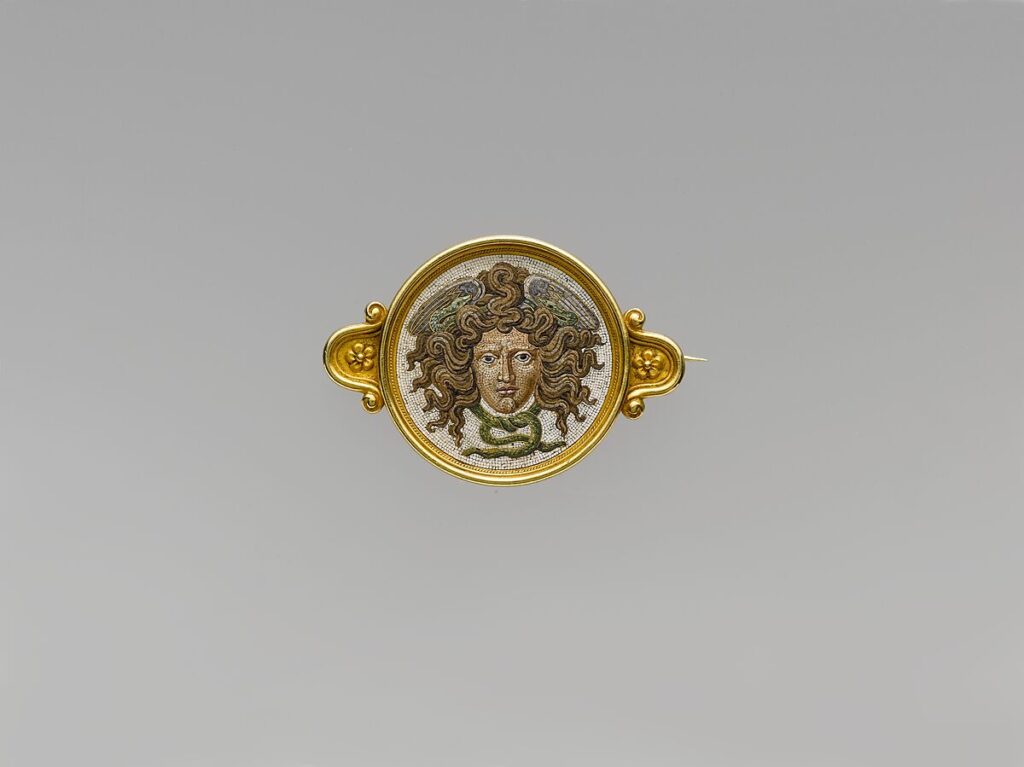
In tiny pieces of glass, Roman artisans recreated monuments, landscapes and paintings. Carried home by Grand Tour travelers, their work found its way into jewelry, interiors and art collections.
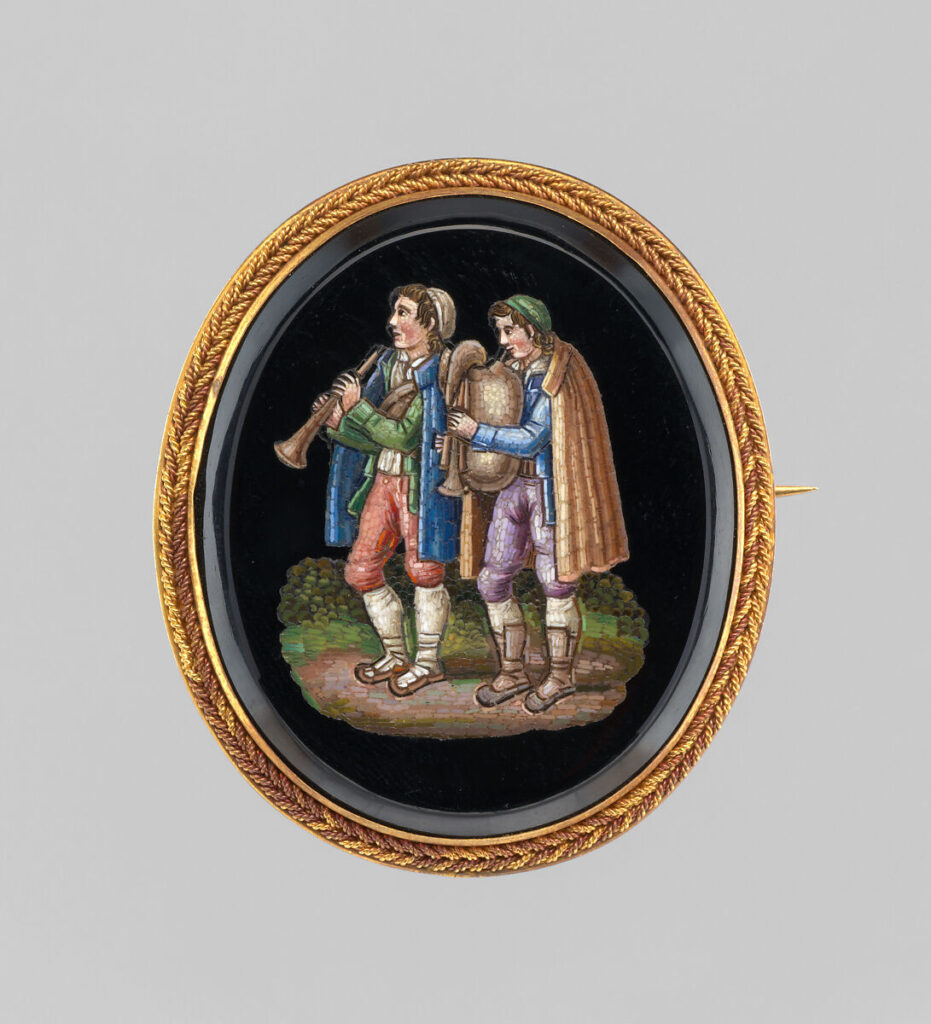
By Letícia Lima Laurino
On a tabletop from 1822, Aurora accompanies Apollo’s chariot. Around the scene, birds, flowers and leaves fill a circular surface. Gioacchino Barberi recreated a composition by Guido Reni using minute pieces of glass. Now in the collection of the Metropolitan Museum of Art, the work preserves the ambition of a painting within a piece of furniture. An image associated with a Roman palace could thus find a place in someone’s home.
This passage from one setting to another helps explain the appeal of micromosaics. Rome provided both the subjects and the artisans capable of fitting them into a box or a brooch. Monuments and landscapes took on a scale suited to the body, everyday gestures and domestic interiors. Bringing one of these pieces home offered a way to keep the place visited present in daily life.
From the late sixteenth century, young European aristocrats traveled through cities such as Paris, Venice, Florence and Rome to complete their education. The Grand Tour required money, time and, often, the company of a tutor. In Italy, classical texts acquired a tangible geography. Ruins, sculptures and buildings previously encountered on the page could finally be seen up close. Visiting collections and acquiring works of art formed part of this education.
These purchases also gave the experience a life at home. Micromosaics belonged to a market in which memories of travel were intertwined with the cultivation of taste. Displaying a view of Rome at home extended the visit and conveyed a familiarity with the culture the Grand Tour taught travelers to admire. The object held a personal experience and made it visible to others.
The delicacy of the work added to its appeal. Composed of fragments of colored glass, some images contain pieces so small they can barely be distinguished with the naked eye. A closer look is enough to reveal the care involved. A scene recognizable from a distance reveals, up close, the meticulous work of the artisan who recreated it. The memory of Rome came with an artistic achievement that invited attention in its own right.
In jewelry, the city could accompany its wearer. A suite preserved at Cooper Hewitt, Smithsonian Design Museum, brings together views of the Colosseum, the Pantheon and St. Peter’s Basilica in pieces with gold settings and blue borders. Necklaces, bracelets, earrings and brooches transformed architecture into adornment. Before photography became widespread, these small images offered a way to preserve the places travelers had seen and express the taste of those who had chosen them.
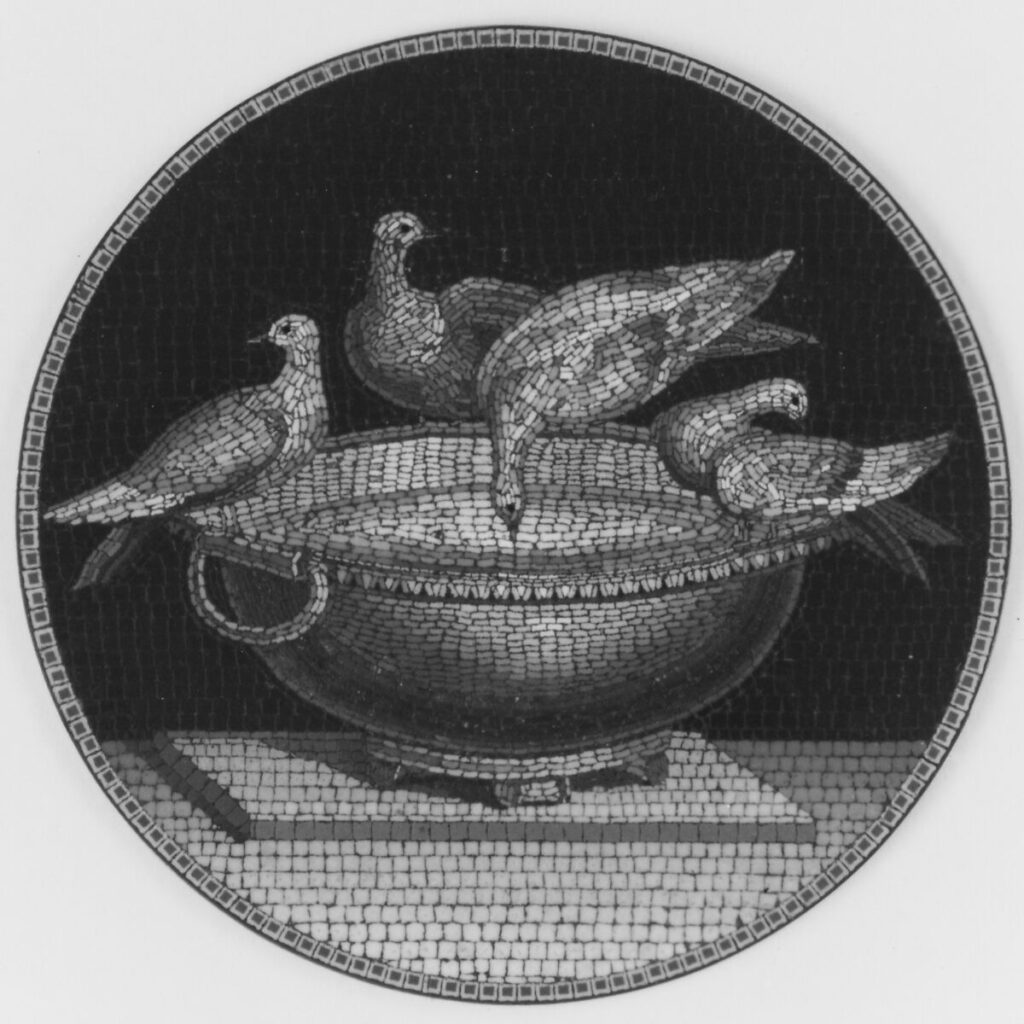
The repertoire also included images visitors learned to admire in collections. The Doves of Pliny, derived from a mosaic discovered at Hadrian’s Villa in Tivoli, became a recurring subject. Depicting the birds gathered around a vessel, artisans revisited a celebrated composition from antiquity. The piece allowed its owner to carry home a reference to the classical world that gave the journey its purpose.
Read more: Basquiat Beyond the Canvas
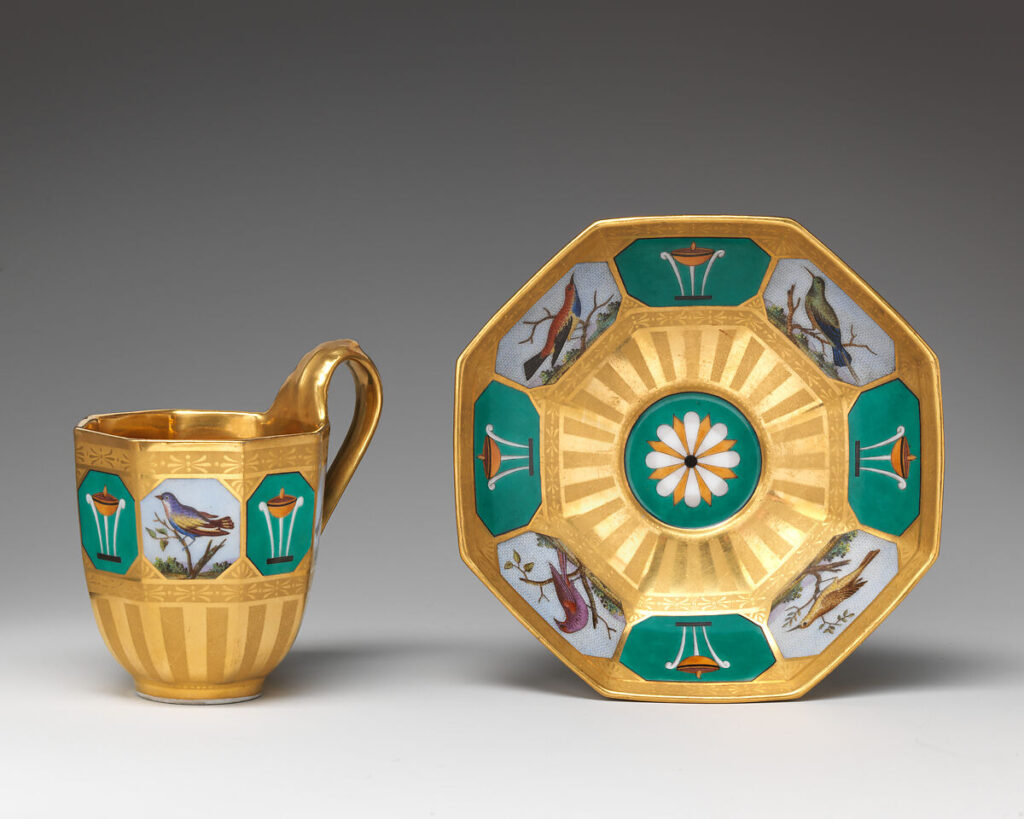
This taste traveled beyond Italy and beyond micromosaics themselves. A cup and saucer made in Berlin around 1817, now at the Met, features birds in a decoration that imitates their appearance. The piece is porcelain, its painted surface reproducing the look of tiny fragments. The popularity of souvenirs brought home by German travelers had inspired the Berlin manufactory. A Roman aesthetic was finding its way into objects made far from Rome.
The presence of these works in collections such as the Arthur and Rosalinde Gilbert Collection at the V&A speaks to their enduring place in the collecting of decorative arts. Brought together through an appreciation of craftsmanship and the beauty of objects, they can be enjoyed by people with no connection to the journeys that prompted their creation. A personal memento had also become an object of public interest.
At the Vatican Museums, a new permanent display of the micromosaic collection opened in May 2025. Arranged in historic eighteenth-century cabinets, the pieces invite close observation. The presentation recaptures something of the way they were originally meant to be seen: objects conceived to inspire an intimate sense of wonder, discovered in their details.
Before them, it is worth beginning with the edge of a wing, a column or the transition between two colors. Then stepping back to take in the whole image. Part of their appeal lies in this shift in distance. A place once visited fits in the hand, yet holds references to a much larger world. The journey explains why someone wanted to bring the object home; the artist’s work helps explain why we still want to look at it.