The Return of The Vineta
On Cocoanut Row, Oetker Hotels restores a Palm Beach landmark as its first American address, giving The Vineta permission to remember itself.
Oetker does not pursue growth for scale. It gathers individual hotels in places of character, each operated with the autonomy of a private house.
The building at the corner of Cocoanut Row and Australian Avenue in Palm Beach has survived four names, multiple closures, and an entire century of the island’s social evolution. It opened in 1926 as the Lido-Venice, one of dozens of hotels that sprouted along Florida’s southeast coast during the land boom of the 1920s, the speculative fever that followed Henry Flagler‘s railroad south and produced a coastline of Mediterranean Revival architecture: stucco walls, arched loggias, clay tile roofs, and a theatrical relationship with sunlight that borrowed freely from the villas of the Veneto and the palazzi of Andalusia. The Breakers, completed in 1926 on the same stretch of island, belonged to this same moment. The Biltmore, built that year in Coral Gables further south, belonged to the same impulse. Within a few years the Lido-Venice was renamed The Vineta, and it carried that name for more than half a century, accumulating the kind of character that architects cannot specify and contractors cannot install: decades of winter-season arrivals, of Worth Avenue shopping bags left in lobbies, of late-afternoon light falling through jalousied windows onto terrazzo floors that nobody photographed because they were simply part of the furniture of daily life. In the 1980s it became a condominium. In 1989 it reopened as The Chesterfield. In 2022, the building closed. It waited. What arrived in 2026 is not merely a renovation. It is a restoration of intent. Oetker Hotels, the German family-held hospitality group whose properties include Le Bristol Paris, the Hotel du Cap-Eden-Roc in Antibes, The Lanesborough in London, and Palácio Tangará in São Paulo, has chosen Palm Beach for its first address in the United States. The decision was characteristically deliberate. Oetker does not franchise. It does not pursue growth for the sake of scale. It acquires what it calls “masterpiece hotels,” individual properties in places of particular character, each operated with the autonomy and personality of a private house. There are currently twelve in the collection. The Vineta is the thirteenth.
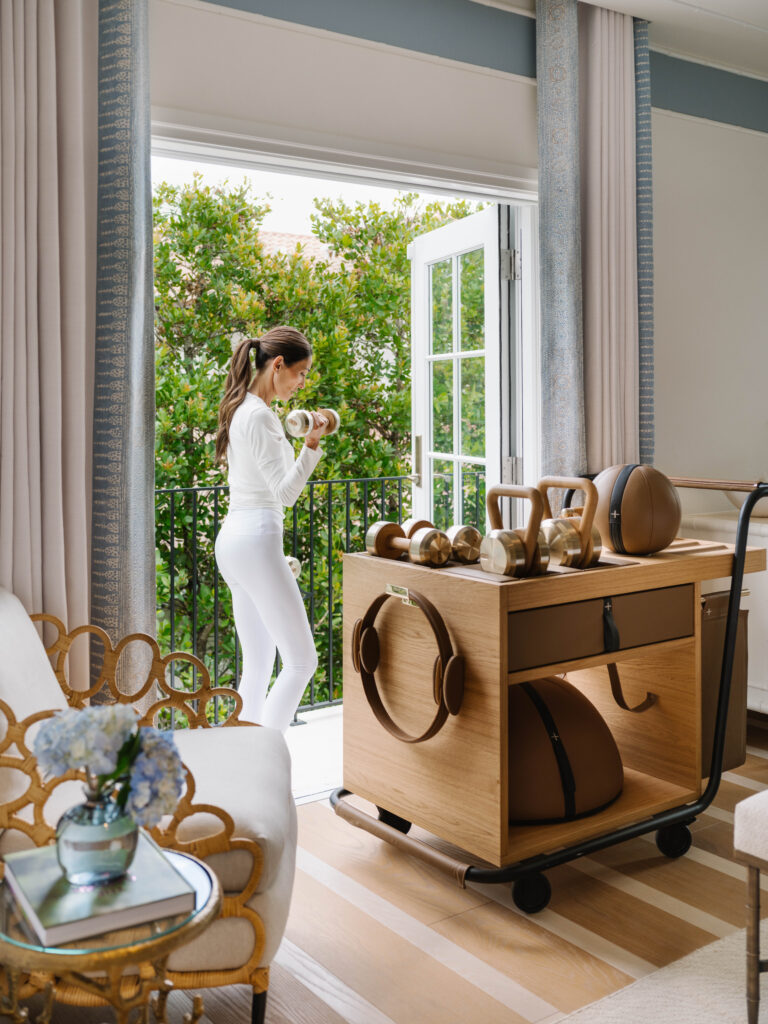
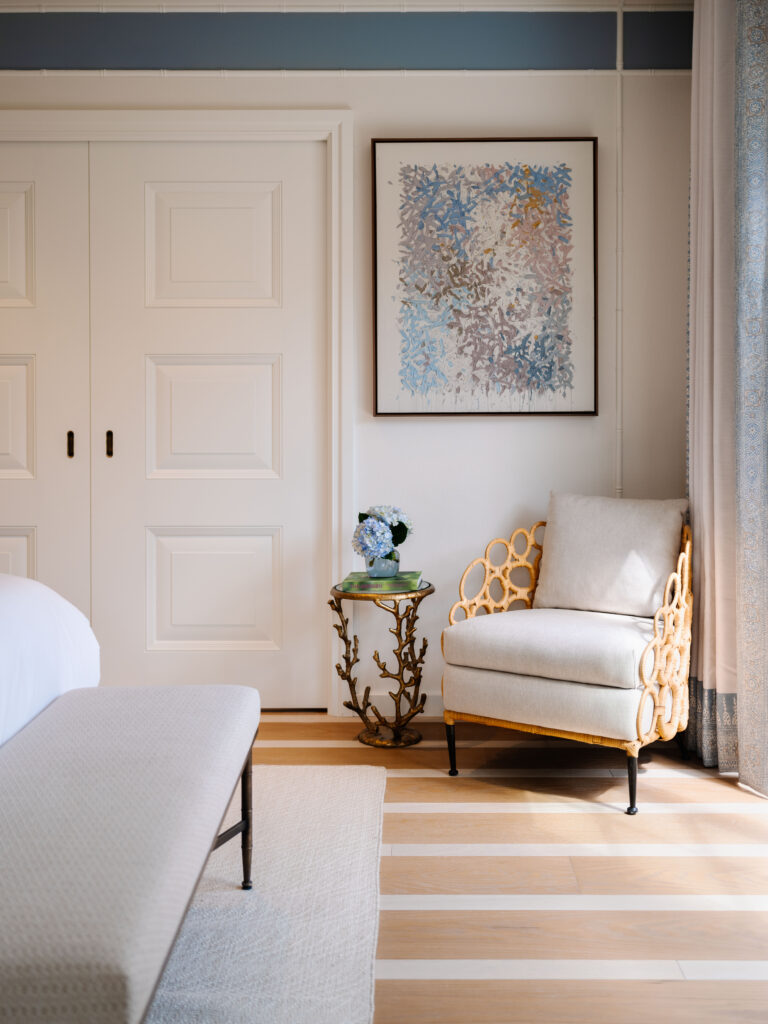
Room at The Vineta Hotel.
The building has stood for a hundred years. What Oetker has given it is not a new identity, but permission to be what it always was.
“The design equilibrium is between the elegance of Europe and the luminosity of Palm Beach, pattern, proportion, and craftsmanship were fundamental.”


— Tino Zervudachi
The interiors were entrusted to Tino Zervudachi, whose studio ZRM works between Paris, New York, and London. His approach at The Vineta reads as a sequence of controlled contrasts: European discipline against tropical informality, historical gravity against contemporary lightness, the decorative richness of the 1930s against the restraint of a twenty-first-century sensibility. The Mediterranean Revival facade, with its original stucco and arched openings, has been preserved. Inside, the forty-one rooms and suites unfold in tones of linen, pale blue, and natural white, layered with surfaces that reward close looking. The terrazzo floors are handmade, their aggregate patterns varying subtly from room to room. The walls are finished in Venetian stucco, a plastering technique with roots in the Veneto of the sixteenth century. Relief panels draw from the decorative vocabulary of the Art Deco period, when the building was new and geometric ornament still carried the energy of invention. “The design equilibrium is between the elegance of Europe and the luminosity of Palm Beach,” Zervudachi has said. “Pattern, proportion, and craftsmanship were fundamental.” The motifs he introduced are layered and associative: wave patterns that reference both the Atlantic and Venetian textile traditions, feather prints that acknowledge the island’s tropical fauna, and constellations that appear on select surfaces, a reminder that Palm Beach, for all its social concentration, remains a place where the sky at night is vast and largely unobstructed. The gastronomic anchor is Coco’s, an indoor-and-outdoor restaurant led by executive chef Brian Rodriguez. Its menu represents something rare in hotel dining: a genuine creative exchange with a sibling property. For the first time, dishes associated with the Hotel du Cap-Eden-Roc (the Steak Diane, the Eden Roc Sea Bass) appear on an American menu, developed in close collaboration with Sébastien Broda, the Eden-Roc’s executive chef, and Tarek Ahamada, its pastry chef. The result is not replication but translation: Mediterranean technique applied to Florida produce, French precision adjusted to a Palm Beach pace. The dining room is dressed in terracotta tones with layered greenery and a red Italian marble bar. A leopard motif on the ceiling makes a knowing reference to the building’s former life as The Leopard Lounge.
The Bar occupies a quieter register. Its walls are finished with Pierre Frey Le Manach fabrics, textiles still produced on wooden hand-looms, and its tabletops are cut from marble plume, a stone whose veining carries a geological drama of its own. The cocktail program, Pan’s Garden, takes its name from the native wildflowers of Palm Beach and translates botanical specificity into liquid form. Outside, the restored original iron gates frame a jasmine-covered patio that serves as the hotel’s most romantic room: one with no roof and no walls. By the pool, another Eden-Roc tradition arrives in America for the first time. Giovanni’s pizzas, previously available only at the trattoria reserved for Hotel du Cap guests in Antibes, are now served at The Vineta’s Pool House, the first time these recipes have left the south of France. The raw bar adds tartare tacos and mahi ceviche, and the setting (retro latticework, undulating architectural details) strikes a tone of relaxed glamour that belongs to Palm Beach without quoting any single era too literally. What makes The Vineta convincing is not its individual details, though each one reflects a specificity that borders on devotion. It is the coherence of the thinking behind them. Oetker’s model has always been familial rather than corporate, intimate rather than scalable. Every hotel in the collection is managed as if its general manager were hosting guests in a private home. At The Vineta, that principle is embodied by Emanuela Setterberg Di Vivo, whose brief is not to create a spectacle but to create a feeling of belonging. “The Vineta always belonged to Palm Beach,” she has said. “Our role was to listen to its history, respect its character, and restore it with sensitivity, warmth, and contemporary intelligence.” The building has stood for a hundred years. It has carried different names and served different purposes. It has watched the island change around it and change again. What Oetker has given it is not a new identity but something more considered: the permission to be, once more, what it always was.