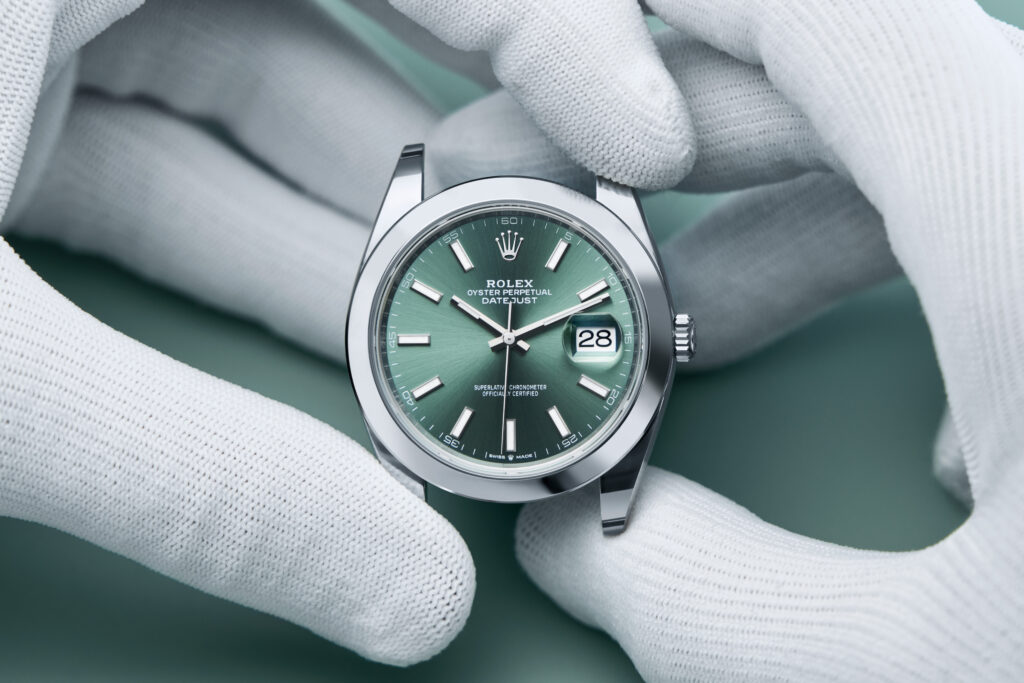
Watchmaking, Final Assembly, 2022. Watchmaker during the final assembly. Detail.
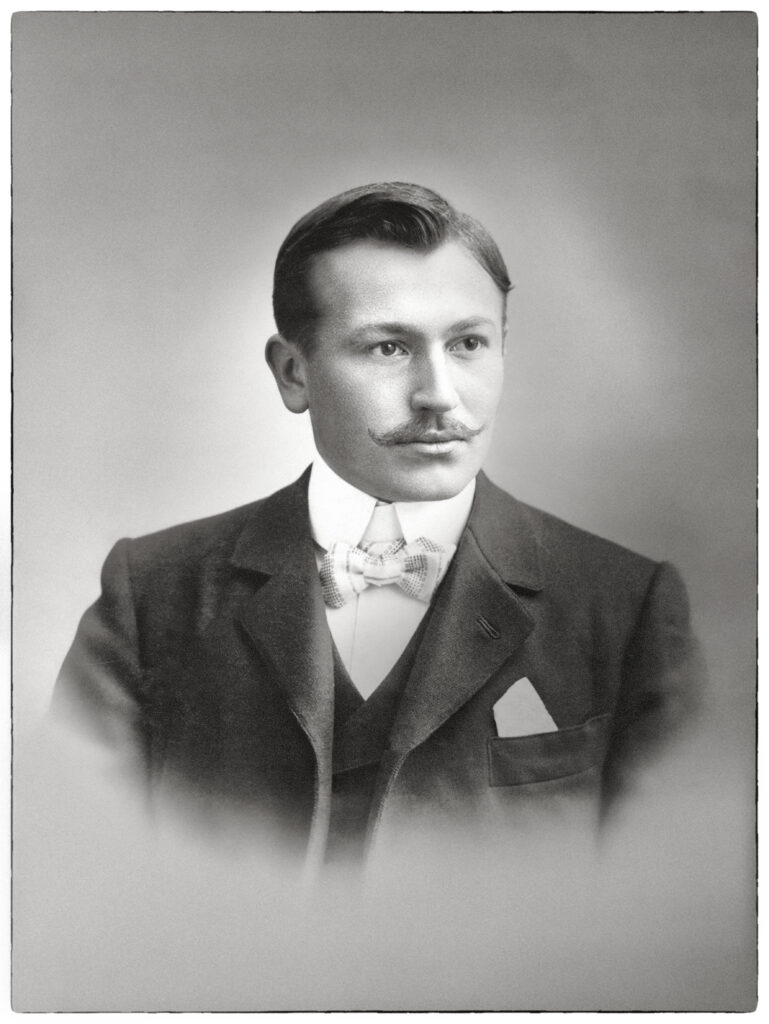
Hans Wilsdorf, founder of Rolex
Before 1926, the wristwatch had a problem it could not solve. Dust, moisture, and the ambient humidity of ordinary life entered through the crown, the caseback, and the bezel, corroding the movement inside. A gentleman’s watch could endure a London afternoon. It could not endure a swim, a monsoon, or a shift on a factory floor. The pocket watch was being replaced by the wristwatch, but the wristwatch, for all its convenience, remained a fragile instrument.

Hans Wilsdorf, the German-born founder of Rolex, regarded this fragility as intolerable. In 1926, he patented the Oyster case: a hermetically sealed housing with a screw-down bezel, caseback, and winding crown that made the wristwatch, for the first time, genuinely resistant to water and dust. The name was deliberate. An oyster is sealed, self-contained, and protects something of value inside. It was not just an engineering solution. It was a proposition about what a watch, and by extension its wearer, might be capable of.

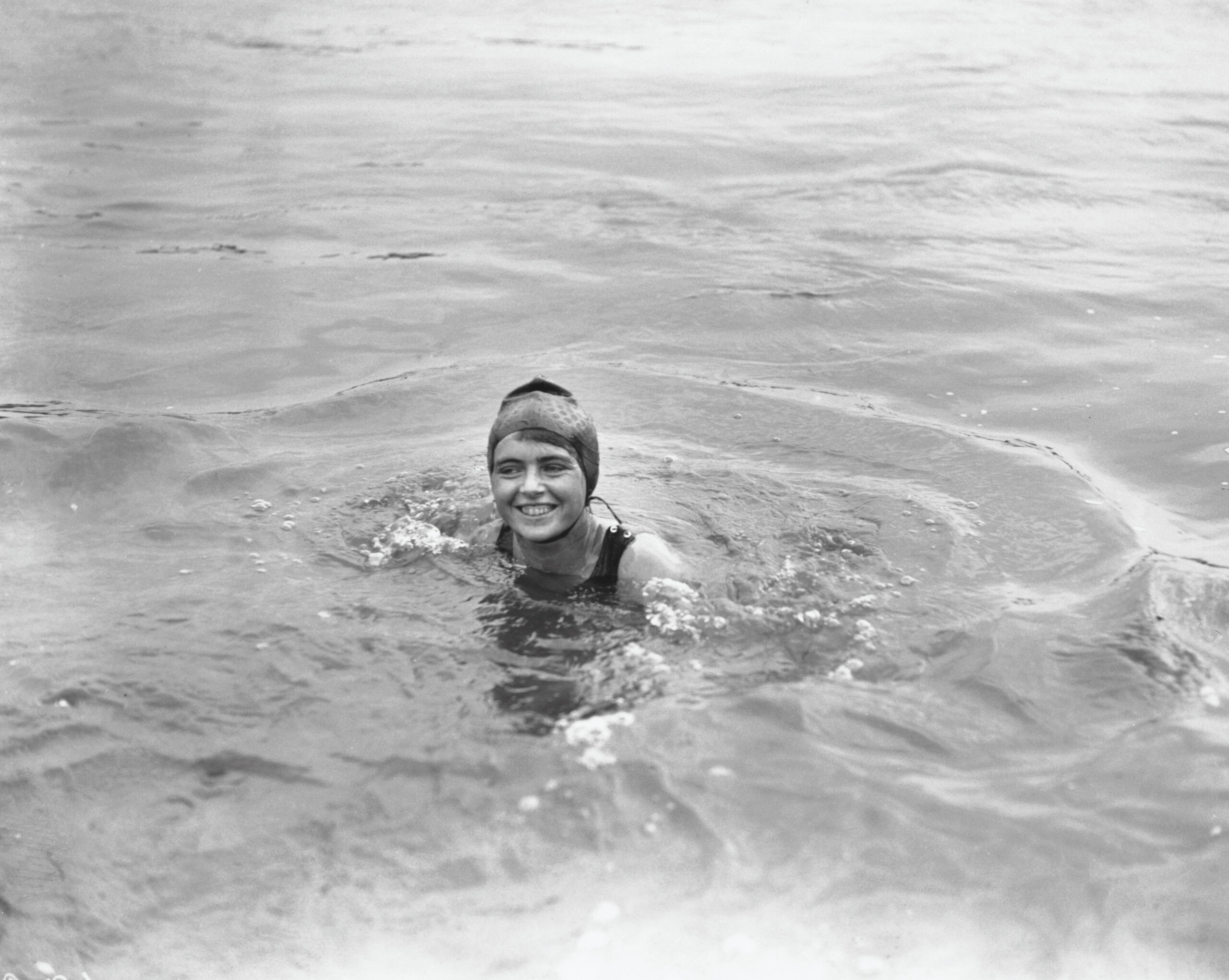
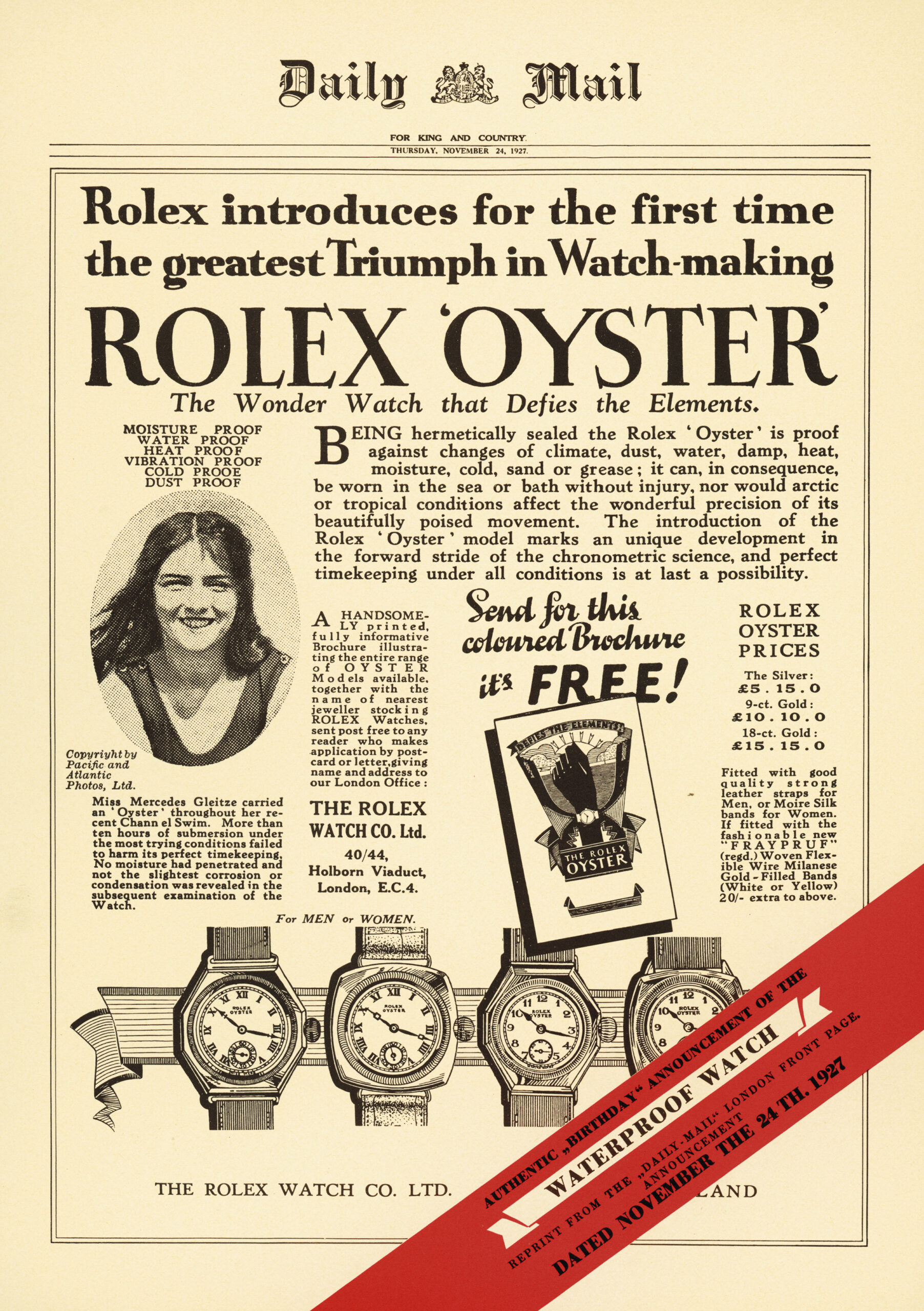
The proof arrived the following year with a calculated piece of theater. In October 1927, the young English secretary and distance swimmer Mercedes Gleitze strapped a Rolex Oyster to her wrist and entered the English Channel. After more than ten hours in cold water, the watch emerged functioning perfectly. Wilsdorf, who understood narrative as well as he understood mechanics, placed a full-page advertisement in the Daily Mail announcing the result. It was among the earliest instances of what would become a defining Rolex principle: associating the watch not with social display but with human achievement, endurance, and the test of both machine and body under pressure.
Mercedes Gleitze swimming the English Channel with a Rolex Oyster on her wrist, 1927.

From that single patent, a century of consequences unfolded. The Oyster case became the structural foundation for virtually every significant Rolex model. In 1931, Wilsdorf introduced the Perpetual rotor, a self-winding mechanism powered by the natural motion of the wearer’s wrist, eliminating the need for manual winding. Three advances — a precise movement, a waterproof case, and an automatic winding system — established the architectural framework of the modern wristwatch. They remain its framework today.

The Submariner appeared in 1953, engineered for diving, initially rated to one hundred meters of water resistance and later extended to three hundred. It was adopted by military dive teams and weekend sailors alike. The Daytona, introduced in 1963, paired the Oyster case with a chronograph calibrated for motorsport timing and became, over decades of waiting lists and auction records, among the most sought-after wristwatches ever produced. The Explorer, the GMT-Master, the Sea-Dweller, the Day-Date: each was a variation on the same Oyster platform, each calibrated to a specific human pursuit, from high-altitude mountaineering to transatlantic aviation to the corridors of diplomacy.

In 2026, at Watches and Wonders in Geneva, Rolex marks the centenary with a series of new Oyster Perpetual references that function as both homage and continuation. Rolex also introduced new Oyster Perpetual references across 41mm, 36mm, 34mm and 28mm sizes. The lead model, a 41mm Oyster Perpetual in yellow Rolesor — an Oystersteel case and bracelet combined with an 18-carat yellow gold bezel and crown — carries anniversary markers that are restrained but unmistakable: the inscription “100 years” at six o’clock, replacing the customary “Swiss Made”; the Rolex name printed in the brand’s signature green; and the numeral 100 engraved in relief on the winding crown. A 36mm reference introduces a Jubilee dial on which the letters of the Rolex name appear in ten distinct colors, applied in sequence, a rare moment of chromatic playfulness from a house that typically communicates in understatement.
Zendaya wearing a Rolex Oyster at the Oscars 2026.
Leonardo DiCaprio and his Rolex Oyster.
Carlos Alcaraz and Jannik Sinner, The Championship at Wimbledon.
First Oyster Perpetual, 1931.
Rolex Headquarters.
Final Assembly.