
Her home, family memories and love of hosting reveal a side of Mônica Salgado that goes beyond the public image she has built throughout her career.
By Letícia Lima Laurino
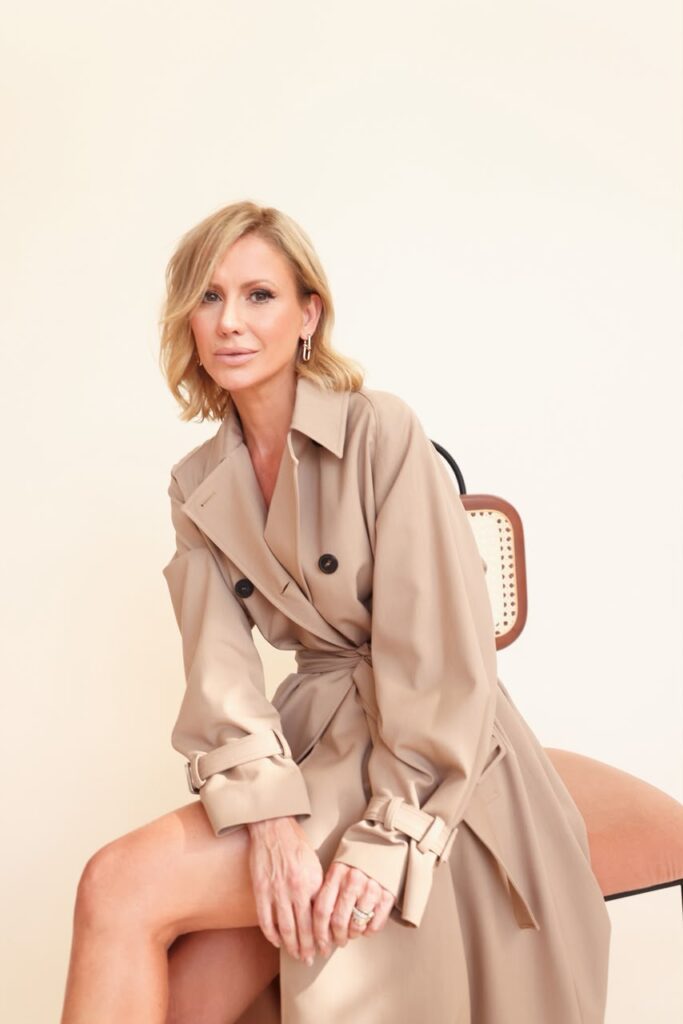
Mônica Salgado knows exactly how she likes to welcome guests, and she isn’t willing to compromise on the details that matter to her. While preparing for Talk com Môni, she chose a pink carpet even though a less expensive black option was available. She also insisted on candles in the bathroom and a pleasant fragrance in the lounge. For her, these details are all part of the guest experience. “That’s when I stop counting costs. That’s when it’s not about spreadsheets,” she says.
Her love of hosting is reflected both in the projects she leads and in her life at home. Mônica strives to create spaces where people feel comfortable, giving importance to the objects and memories that are part of her story.
That same attention to detail is evident in the way Mônica invests in her own home. Lighting and the art of setting a table play an important role in her daily life. A color may feel right for years and then suddenly no longer reflect what she wants to express. These choices evolve along with her, while remaining connected to the care she puts into making others feel welcome.
Among her most cherished possessions is the dinnerware inherited from her maternal grandmother. As a child, Mônica loved watching her grandmother prepare desserts, and as she grew older, she maintained that same pleasure in bringing people together around the table. Her family recognized that she would carry on this tradition and passed the dinnerware down to her. Some pieces are chipped, while others have patterns faded by years of use. Despite these signs of age, they remain part of the table whenever Mônica hosts at home, carrying her grandmother’s memory and a tradition she has chosen to keep alive.
Her personal taste influences the projects and work she takes on, but not everything can be organized or adjusted with the same ease, especially when other people are involved and she must reconsider her own boundaries.
To get to know the Mônica behind her public image, Lifestyle Mag spoke with her about her career, motherhood, personal choices and the challenges of balancing different roles. Read the full interview below.
Photos: Courtesy of Mônica Salgado

The Interview
Lifestyle Mag: When we spoke with you in 2023, we talked about your career, family, projects and some of the little things that were part of your life at the time. If we could put the Mônica of 2023 and the Mônica of today side by side, what would be the first difference you’d notice?
Mônica Salgado: So much has happened since 2023! Back then, I was an influencer, I gave talks, and I had Talk com Môni, which was a mid-sized event. Since then, we’ve grown considerably. Our event keeps attracting more people, more speakers, and has become better positioned in the market.
Today, we position ourselves as the Fashion Week of influencer festivals because I think we’ve managed to find a space that’s very much our own: an event that brings together glamour, positioning, interesting and engaging experiences, and connections. Our audience is a little older, mostly women over 30 or 35, entrepreneurs and independent professionals from all over Brazil. Talk has grown, gained visibility and established its position, and that makes me very proud. In 2027, we’ll have a two-day event for the first time. Back in 2023, I had no idea any of this would happen.
I released my book in 2024, and it opened so many doors for me. We went on a promotional tour through more than 25 cities in Brazil. We also launched it in three countries, traveling to Miami, Lisbon and Madrid.
Some of these projects weren’t entirely new but gained momentum, while others were new opportunities that emerged and greatly expanded the scope of my professional work. They really shifted my role from influencer to businesswoman. I think I came to understand the weight of my decisions and how many people, brands and businesses were affected by these projects.
I also have The Talk magazine now, which will launch in February 2027. We’re wrapping it up later this year. It will be a women’s magazine, but not a print publication, and I want to release it twice a year. That will also be very special.
LM: You’ve spent much of your professional life editing: a story pitch, a magazine, a story, an image. If you could apply that editorial perspective to your own life today, what have you learned to cut without guilt, and what definitely deserves more space?
MS: Editing a text is so easy. Editing a magazine is so easy. Real life doesn’t give you those options because it’s not something you can control. There are so many variables that don’t depend on you, and that’s where things get complicated.
Take marriage, for example. You’re dealing with another person, and it’s complicated. A child, my goodness, that’s the human being you love most in the world. That’s the person who’s going to walk all over you, humiliate you, and you’ll always come back with your tail between your legs, wagging it and saying, “Yes, of course.” Because that’s what love is like. We keep reassessing our boundaries depending on the situation.
I think that, both personally and professionally, dealing with so many variables has become increasingly difficult. Today, we’re dealing with the political situation in our country, which has sadly divided us in two. I’m someone with strong opinions, and I feel the consequences of that firsthand in my contracts, my relationships and the people I’m able to bring into my projects.
Editing my life today would mean understanding which projects and jobs still make sense and which no longer do. I think maturity and financial prosperity help us make those decisions. As I approach 47, I have a better understanding of what brings me satisfaction. We’re constantly weighing satisfaction against compensation. Those are the two variables that end up having a major influence on our decisions.
Today, thank God, compensation is still an extremely important factor, but I can afford to let satisfaction carry more weight. That’s what ultimately shapes my curation, my editing and my choices.
LM: A Vida que Não Postamos was born out of an interest in what exists beyond the carefully curated image. After turning that reflection into a book and sharing it with so many people, is there any part of your life you’ve become even more protective of, resisting the urge to turn everything into content?
MS: Look, I think one of the defining characteristics of my work and how I position myself is this brutal honesty I have. It’s not a marketing decision, something I do to position myself one way or another, to get work or not get work. It’s not such an intentional choice. It probably should be, if you think about it, but it ends up not being. It’s more of a very visceral way of opening up on social media about my personal struggles and anxieties.
That’s still very much a part of who I am. I don’t think maturity is going to take that away from me. The way I’ve built my story on social media involves content, of course, but it also involves sharing pain and anxieties that people can identify with. I think I’ve also gotten to where I am because people can see their own pain in mine, and I can see mine in theirs, and we connect: “My God, I’m not the only one who feels this way.”
From there, we form a bond that perhaps sets my positioning apart from that of so many other influencers. It’s very difficult for me to theorize about things that aren’t part of my own experience. I talk about things I live through. I’m the mother of a teenager, so today I talk about parenting a teenager. I run a business, so I talk about business. I’ve been with my husband for 30 years, so I talk about long-lasting marriages.
I only talk about things I actually experience. I think that creates a sense of authenticity in my content that is very beneficial when it comes to building a community that shares my values.
LM: For someone who has worked with communication, image and public exposure for so many years, has silence taken on a different meaning over time? When do you most enjoy simply having nothing to say?
MS: I always have something to say about everything, and that’s exhausting. It’s just my nature.
I think maturity can help us tame our nature, but it doesn’t eliminate it. Our essence, what we’re made of, isn’t something maturity can erase. You can tame it, soften it, let’s say. I don’t really have much more to add to that question, either.
LM: After so many interviews, conversations and stories, what can still immediately spark your curiosity? What makes you think, “I need to know more about this person”?
MS: I’ve always been very interested in people, in the sense that I’m curious. When I was a child, my parents used to say I’d walk into a room, even if I wasn’t part of the conversation, and ask, “What? Who?” That’s who I am. It comes naturally to me. I like knowing things, doing research, finding out what you think, what you believe, what your story is and where you come from.
I don’t think anyone chooses journalism as a profession without having that instinct inside them, that desire, that curiosity, that natural interest. It’s what made me choose the profession, and it has continued to shape me. I like understanding what drives people. That has had a major influence on my career, who I am, the direction I’ve taken, my businesses and my interests.
Everyone inspires and intrigues me. Everybody has a story to tell, a life. Everyone has made mistakes, gotten things right, fallen down and gotten back up. The human experience itself is what interests me.
LM: For many years, your work also involved putting other people at the center of the story. More recently, you’ve increasingly taken the stage with your own voice. What have you learned about being the main character after spending an entire career observing and interviewing others in that role?
MS: I think this whole idea of being the main character was a bigger issue for me in the past. When I left Glamour in 2017, after spending my entire life behind the scenes, it felt strange to find myself in a situation where my own life was also attracting interest. Eight or nine years ago, that was much more challenging.
Today, I don’t think it is anymore. The landscape is very different from when I worked in the press for a major media company. The boundaries, the barriers, are more fluid. It’s no longer about you as a private individual versus you as a business entity. You’re just you, this whole combination of things. The world has changed so much that it no longer scares me.
I give a lot of talks throughout Brazil. I travel all over the country, from north to south, and that’s not an exaggeration. I’ve been to so many cities, every region and state you can imagine. I meet very different people, but at the same time, they share many of the same values and principles because they’re people who connect with me and want to bring me to their cities.
Today, I’ve made peace with this idea of one Mônica on one side and another Mônica on the other. There’s only one Mônica. In my work and personal life, I have that integrity. This is who I am: what I say, think and do are consistent with one another. Everything is aligned. There are no loose ends in that process.
I think the people who hire me professionally also hire me because of how I conduct myself in my personal life. Today, it’s all very connected.
LM: Talk com Môni has grown and evolved so much since our first conversation. You’ve spoken about the care you put into welcoming people there, almost as if you were hosting them in your own home. Outside of major events, what does being a good host mean to you? What can never be missing when the people you love gather around your table?
MS: I think I got some of that from my grandmother, my mother’s mother, who was always the ultimate grandmother. She cooked, hosted, brought everyone together around the table and taught me so many recipes. I was the only granddaughter who was interested. She taught me how to make cakes and her signature recipes, especially desserts, because children want to know how to make sweets, never how to make roast meat.
My grandmother played an important role in that. She brought the whole family together around the table, without any formality. It was the table of a middle-class Brazilian family, but it was full of warmth. I’ve always loved parties and hosting people at my home. My mother, for example, isn’t like that. It’s not something I learned from her.
I love welcoming people, setting the table and having beautiful dinnerware. When my grandmother passed away, she had all this old dinnerware that had been passed down through generations of the family. Some pieces are broken, others have patterns that have faded a little, but all of it was left to me because the family knew I would carry on that tradition of hosting. I genuinely love it.
And it’s not just about hosting at home. With Talk com Môni, which will have its seventh edition in 2027, I’ve had that same attention to detail since the very first edition. I don’t have a business partner, it’s just me, but my producers will say, “Let’s cut this, let’s cut that.” And I’ll say, “I’m not cutting that.”
There have to be candles in the bathroom. That’s how particular I am! I want a lovely room spray in the VIP lounge so that when people walk in, they feel they’re in a cozy, elegant environment. Scent has so much to do with that. I’ve always been against cutting costs when it comes to providing experiences for people.
Anyone who works in events knows how this goes: “Mônica, but this pink carpet? Why don’t you use the black one? The black one is already there, the supplier has it and can put it down for you. The pink one costs three times as much.” But I want the pink one because pink is the color of my event.
I always want to welcome people the way I would welcome them into my home. That’s very important to me. Talk isn’t a corporate event held in an auditorium or a large event venue. It took place at JK Iguatemi, and now it’s held at Hotel Unique, because these are places that can welcome us with soul, care, attention to detail and experience in luxury hospitality.
That’s what I want for my event, and I won’t compromise on it. I think that’s what defines my positioning. That’s when I stop counting costs. That’s when it’s not about spreadsheets.
LM: You’ve been surrounded by fashion for decades. After seeing so many trends, collections, images and cycles come and go, what no longer has the power to seduce you? And what can still make you stop and take a second look?
MS: More than being passionate about fashion, I’m passionate about aesthetics. I like things that challenge me, that intrigue me visually. When we talk about fashion, we’re talking first about the visual and then, of course, the sensory experience and the other senses.
I’m a Libra with Aquarius rising. My Libra side gives me this very strong aesthetic sensibility. I like order, harmony and beauty. For me, beauty will always be more classical, connected to symmetry, elegance in lines, concepts and colors. That really affects me, and I need to be surrounded by it.
I’m constantly changing the decor in my home, changing the colors, the rugs. When I moved, for example, the walls were gray. Then I said, “This gray doesn’t speak to me anymore,” and painted them green. Two years later, I thought, “I want pink, something lighter, more delicate.”
I’m always changing things because I need to be surrounded by visual elements that reflect what I want to express at that particular moment. I keep emphasizing this because it’s not just about fashion. To me, a house is a home. Today, I invest much more in my home than in my wardrobe. Partly because things for the home are so much more expensive. But I love investing in it, and I love changing the decor.
What makes me stop and look twice is beauty. I was at Paris Fashion Week and saw so many beautiful things that caught my attention. They don’t have to be outrageous or completely out of the ordinary.
I think that, for a while, fashion became seduced by the idea that, to attract attention and go viral, it needed to do something very different, something shocking. I don’t see that as beauty. It can be provocative, it can be many things, but beauty, to me, is beauty. It has a connection to the classics, to symmetry, to concepts that make us sigh, sometimes without even knowing why.
LM: In 2023, you told us you were completely passionate about scents and that you had candles, sprays and fragrances throughout your home. Is that connection to scent and memory still as strong? What smell immediately makes you feel “I’m home” today?
MS: For me, home today smells like lavender. Absolutely lavender. It’s something I love. I have it from several different brands because lavender scents vary. I have sprays, candles, those more diluted linen waters you spray on clothes. I have everything in lavender. I love it.
LM: No travel, no events, no important dinners or professional commitments: what would an absolutely ordinary but perfect day in Mônica’s life look like?
MS: An ordinary, perfect day is one when I get up to take my son to school, he’s in a good mood and chats with me along the way, which doesn’t always happen.
Then I come home and have a long, leisurely coffee. I have a quick coffee with him in the morning, but I want to come back and have another one, maybe two more. Sometimes my husband is already awake, and we have another coffee together.
After that, I get on the stair-climbing machine I have at home, do an hour on it, stretch, take a shower, put on my work clothes and get on with my day. Whether it’s a day working from home or a day of meetings outside, when I’ve taken care of those first things, everything flows better because I already feel a sense of accomplishment.
LM: What’s one small indulgence you refuse to give up, something that might seem completely unnecessary to someone else but genuinely makes your day better?
MS: I think it’s those little touches of charm I won’t give up. A lovely scent, indirect lighting, lighting in the garden. At least in my house, the boys don’t really appreciate those things, but to me, they’re what make a home feel cozy. That’s something I don’t cut corners on. Thank goodness I work so I can make it happen!
LM: You’ve told us about your love for Paris. When you return to a city you know so well, what are you looking for these days: novelty or familiarity? Is there a ritual that makes you feel less like a visitor and more like you belong there?
MS: I have my rituals. In Paris, there are places I love and always need to visit because they make me feel at home.
I remember when I first started going, when it was all, “Wow, I’m in Paris!” I still feel that way, but when it was genuinely new to me, there were places I absolutely loved being. Café de Flore, which I didn’t manage to visit this time, L’Avenue, which I love, and Caviar Kaspia, which I also love.
They’re restaurants I used to follow and dream of visiting. When I finally made it there, I thought, “I made it here!” Today, they still hold that same value for me.
LM: Time often quietly rearranges our priorities. What has become less important to you in recent years? And what, on the other hand, have you started taking much more seriously?
MS: Appearances, what other people think, what the industry thinks. All of that has become less and less important to me. What has become more important is integrity. Are what you think, say and do aligned with what you truly believe?
For me, today, they are aligned. And that’s something I won’t compromise on.
LM: Among all the roles naturally associated with your name — journalist, author, communicator, entrepreneur, mother, public figure — is there a side of you that people who follow you rarely see, but that takes up a huge part of your real life?
MS: The homemaker! Nobody knows that I might be about to walk onstage to give a talk to 300 people while making a Pix payment for my four dogs’ baths.
There are so many things, and not just in my life, but in everyone’s personal life. There’s the produce shopping, the grocery shopping, salaries, employees. These are things people don’t see, but sometimes you’re walking into a huge, super-glamorous event while taking care of all those everyday payments.
LM: After so many years of being interviewed and asking questions yourself, what’s the one question nobody asks Mônica Salgado that you’d love to answer?
MS: “Who am I?” or “Mônica, who are you?”
I don’t know how to answer that. Nobody does.
Maybe that’s the beauty of the question.