
For nearly two centuries, Christofle has followed the changing ways in which we live, celebrate and welcome others into our homes. From the grand French table to the informality of an aperitif, the Maison suggests that tradition survives not by standing still, but by remaining part of life.
There was a time when a table could reveal almost everything about the evening ahead. The placement of the silverware, the porcelain selected for dinner, the glasses waiting to be filled, even the distance between one setting and the next belonged to a language understood by host and guest alike. Long before anyone sat down, the table had already begun the conversation. We receive differently now.
Dinner may begin with friends gathered in the kitchen. An aperitif stretches longer than expected. Champagne is opened because someone stopped by, not because an occasion demanded it. The boundaries between kitchen, dining room and bar have softened, along with many of the rules that once governed them. Yet the desire behind those rituals has hardly disappeared. We still set a table because someone is coming. We still choose an object because it makes an ordinary gesture feel considered. If anything has changed, it is our understanding of formality. Hospitality today can be meticulous without looking ceremonial.
Few houses have had as long a view of that evolution as Christofle. Founded in Paris in 1830 by jeweler and entrepreneur Charles Christofle, the Maison became a supplier to King Louis Philippe and later to Emperor Napoleon III. Its work entered royal and imperial residences, important public settings and some of the great symbols of French life.
On May 29, 1935, when the Normandie sounded its horn at Le Havre before departing for New York, 40,000 Christofle pieces were aboard. The ocean liner was conceived as a floating expression of French art, design and hospitality, and its dining rooms carried the rituals of the European table across the Atlantic.
It is an irresistible image: thousands of pieces of silver moving toward America on one of the most glamorous ships of its age. But history alone does not explain why Christofle remains interesting. The more revealing story is what happened as the world around all that silver changed.
THE HAND AND THE OBJECT
Inside Christofle’s workshops, the vocabulary is considerably older than our contemporary ideas about entertaining.
Metal is shaped, hammered, spun, chased, engraved, assembled and polished. Each stage requires a particular understanding of the material. Too much force at the wrong moment can damage a piece. An assembly, however complex, should disappear into the finished object. In the French silversmithing tradition, evidence of construction is not meant to compete with the purity of the final form. Much of the beauty, in other words, lies in work the owner may never see.
This knowledge has moved through different Christofle workshops. The first was on rue de Bondy, now rue René Boulanger, in Paris. In 1877, the Maison opened a larger manufacturing site in Saint Denis. Nearly a century later, construction began on the Yainville manufacture in Normandy, which remains in operation today. The addresses changed. The hand remained essential.
Christofle describes its master silversmiths as guardians of a living heritage, an idea that becomes less abstract when one considers the accumulated knowledge required to make an object appear effortless.
The archive tells another version of that continuity. More than 60,000 records are preserved by the Maison, while the small marks impressed upon its pieces create a history of their own.
Christofle’s first maker’s mark, registered in 1832, combined the initials CC with a rifle bayonet. Later came a bee beneath three stars, the balance mark and, from 1935, the chess knight framed by the initials OC, for Orfèvrerie Christofle.
Tiny symbols, intended to remain on objects that may outlive their first owners. That distinction matters. Christofle does not make sense as a story about preservation alone. Its most compelling objects exist precisely because someone eventually takes them out, places them on a table and uses them.
WHEN DESIGN CHANGES THE RITUAL
Christofle has long invited outsiders into its vocabulary. Jean Cocteau and Man Ray are part of that history, as is Gio Ponti. Over the decades came Lino Sabatini, Andrée Putman and, more recently, designers and studios including Marcel Wanders, Nendo, Sarah Espeute, Elliott Barnes, Aurélie Bidermann and Charlotte Chesnais.
The significance of those collaborations is not simply the collection of famous names. Each generation has been given permission to reconsider what a Christofle object might look like and, more importantly, how it might behave.
Andrée Putman’s Vertigo collection, created in 2002, is an elegant example. Its recurring gesture is an asymmetrical ring that becomes a handle, support or structural element depending on the object. Putman’s intervention is immediately identifiable, yet sufficiently restrained to have remained contemporary more than two decades later. Then, in 2015, Christofle did something more radical. It moved the silverware.
For centuries, the placement of cutlery had been among the most codified elements of the Western table. Christofle took those pieces from their prescribed positions and gathered them inside a polished ovoid object placed at the center. It called it MOOD.
MOOD, 2015
The table, unset
At first glance, MOOD appears to be a polished metallic sculpture. Open it and a complete flatware service is revealed inside, arranged vertically around its core.
Instead of the host deciding where every piece should sit before dinner begins, the object allows guests to take their own silverware from the center of the table. The shift is subtle but meaningful. Christofle did not remove ritual from the table. It replaced one ritual with another, exchanging prescription for participation.
Since its introduction, MOOD has developed into a family designed around different moments, including coffee, parties, Asian dining traditions, children’s settings and aperitif. A house famous for the formal table had found an icon in an object that gently dismantled it.
WHAT DOES IT MEAN TO HOST?
There is a difference between placing beautiful things on a table and understanding what happens around them. That difference increasingly defines Christofle’s contemporary language.
The Maison’s idea of hosting reaches beyond being present on the table. It is about being present with the people around it, creating objects that participate in moments of conversation, celebration and belonging.
This may sound emotional for a company associated with metal, but objects have always carried emotional lives alongside their practical ones. A baby cup engraved with a name becomes something entirely different after it has passed through a family. The silverware used every Sunday acquires a meaning that cannot be reproduced by buying another set. A tray remembers breakfasts, drinks, guests and rooms. We attach stories to objects because they were there.
Perhaps that is why the idea of inheritance feels particularly relevant to Christofle. Its Vintage Collection takes pieces from earlier periods, selects and restores them according to the Maison’s standards, and returns them to contemporary life. The proposition is more interesting than simple nostalgia. These objects are not being rescued so that they can remain untouched. They are being prepared to be used again.
LA COLLECTION VINTAGE
Another life
Christofle’s past is not confined to an archive. Through La Collection Vintage, selected pieces from earlier periods are restored using the Maison’s savoir faire before returning to circulation.
A tray or serving piece may therefore enter a new home decades after it was made and acquire an entirely different history from the one it had before. The idea is both cultural and practical: craftsmanship proves its endurance not simply because an object survives, but because somebody still wants to live with it.
PARIS AFTER DARK
Club 30, Christofle’s newest collection, begins with another kind of memory.
This time it is Paris in the 1920s and 1930s, when grand hotel bars, music halls and intimate lounges helped create a mythology of the city after dark. Champagne, cocktails, music and the freedom of the evening belonged to a social culture whose visual language became inseparable from Art Deco.Christofle returns to that atmosphere without attempting to reproduce it.
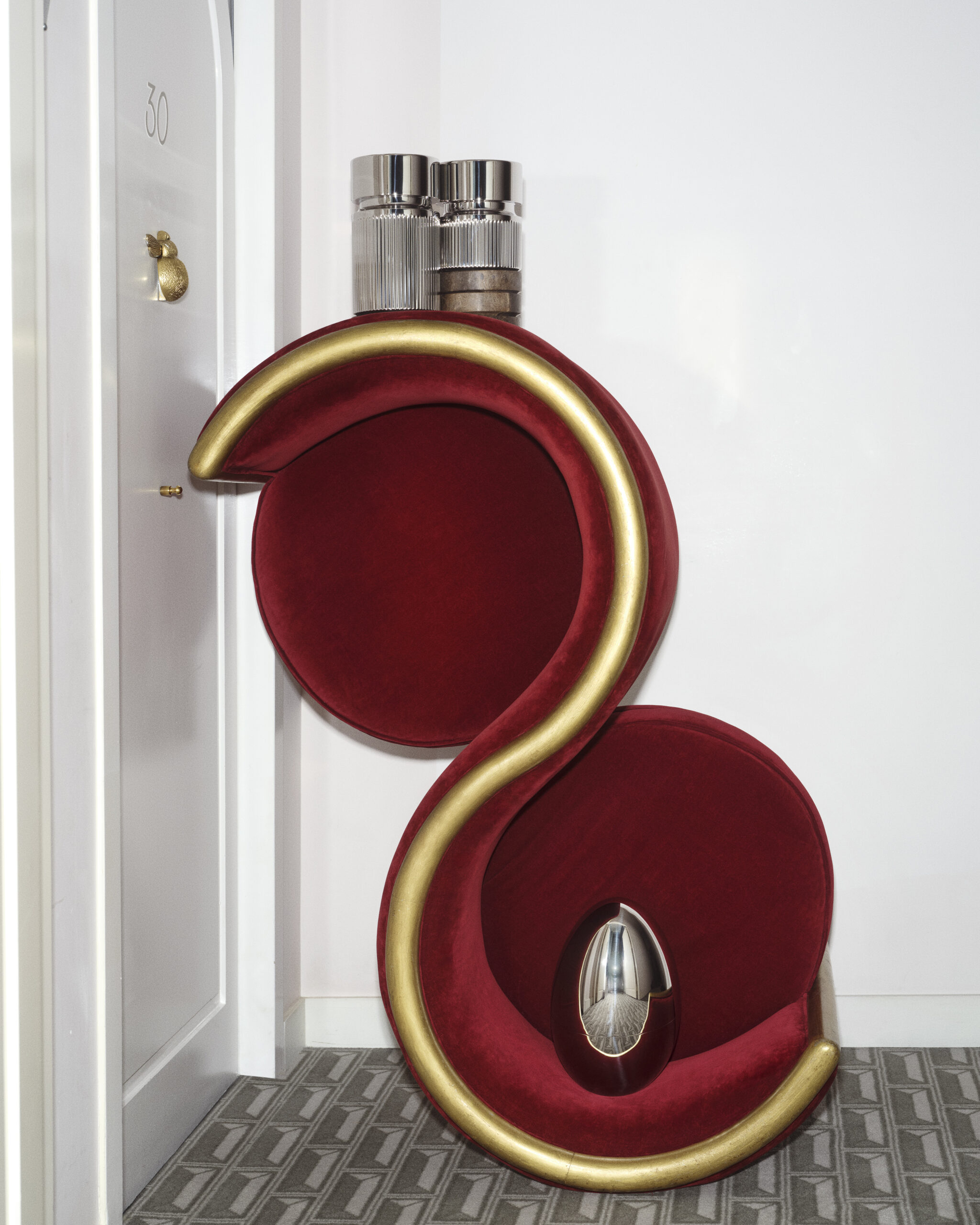
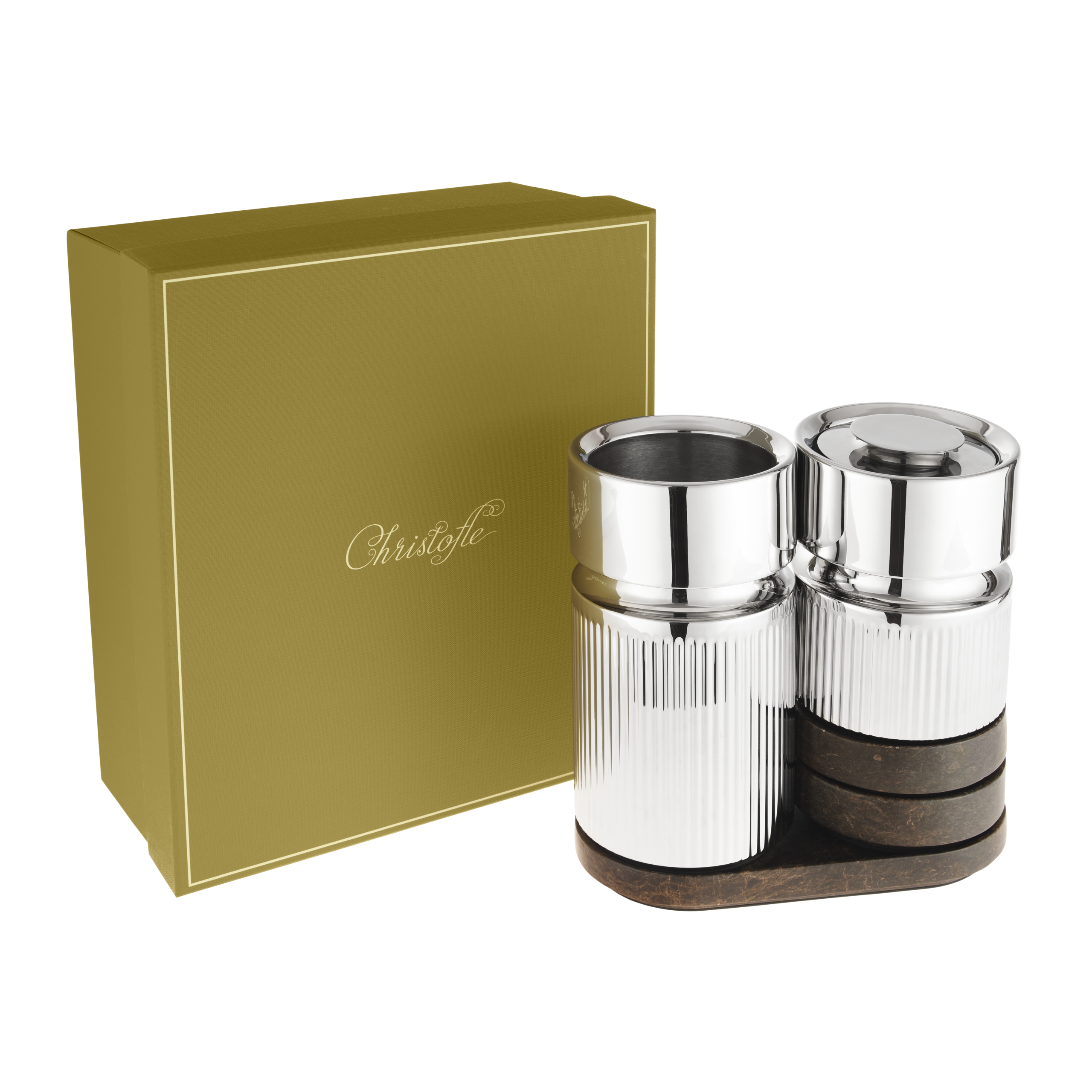
Club 30 borrows its vertical fluting, generous curves and polished surfaces from the period, then places them within objects designed for contemporary entertaining. The center of the collection is a five piece bar set conceived almost as a small piece of architecture. A champagne bucket, ice bucket, aperitif tray and serving bowls come together as a sculptural composition, then separate as they are needed. It is designed to remain visible even when no one is having a drink.
That distinction is important. The contemporary bar is no longer necessarily hidden behind doors or reserved for a formal drawing room. It has become part of the domestic landscape. Bottles, glasses and bar objects live in kitchens, libraries, living rooms and open spaces, often in full view. Club 30 responds accordingly.
CLUB 30, 2026
The bar, reimagined
Inspired by the Parisian nightlife of the 1920s and 1930s, Club 30 brings Art Deco references into a collection made for the way people entertain now.
The five piece set combines stainless steel with brown marble, a first for Christofle in this configuration. The contrast gives the collection much of its character: reflective metal against stone, cool surfaces against warmer ones, precise fluting against the natural variation of marble.
There is pragmatism behind the choice as well. Stainless steel makes the pieces easier to maintain while allowing Christofle’s characteristic mirror polish to remain central to the design.
The engineering is equally considered. Different steel finishes are combined within the pieces, while double wall construction is used in their upper sections. The ice bucket is entirely double walled for thermal insulation.
The collection extends beyond the set to individual objects including a champagne bucket, ice bucket and ice tongs. Nothing about Club 30 asks to be saved for later. That may be its most contemporary quality.
A FRENCH TABLE, RECONSIDERED
To understand the distance Christofle has travelled, it helps to look back at Marly.
Created in 1897 and named after the Château de Marly, Louis XIV’s retreat outside Paris, the collection is richly decorated with plant motifs. It belongs unmistakably to the tradition of the elaborate French table, where ornament itself helped establish the importance of an occasion. More than a century later, Marly remains part of Christofle.
So does Malmaison, whose palmettes and water leaf motifs recall the Empire style and the world of Napoleon and Joséphine. Rather than abandon that vocabulary, Christofle has continued to reinterpret it through later variations.
The interesting question is not whether Marly and MOOD look as though they came from the same moment. Clearly they do not. It is whether both can belong to the same Maison. They can because the continuity lies somewhere deeper than style.
MARLY, 1897
The French table
Named for the Château de Marly, Marly embodies the decorative confidence of the late nineteenth century. Its dense botanical ornamentation reflects a period when the setting of a table was itself a form of social expression.
Seen beside MOOD or Club 30, Marly becomes particularly revealing. The three collections could hardly be more different in appearance, yet each responds to the way people wanted to receive in its own time. The objects changed because life changed.
CREATE TO BE SHARED
Christofle’s motto is remarkably concise: “Create to be shared.” After nearly two centuries, it may also be the simplest explanation for the Maison’s longevity.
A beautiful object can be admired alone. A table object, however, becomes fully itself in company. Someone pours from it, passes it, reaches for it or places something inside it. It exists within an exchange.
In October, Christofle will bring its latest chapter to New York before the presentation travels through the United States through the end of the year. Club 30 provides the occasion, but the larger story is not a launch. It is the continuing negotiation between heritage and life.
The silver service aboard the Normandie, Marly’s nineteenth century ornament, Putman’s asymmetrical ring, the MOOD sitting open at the center of a table and a Club 30 champagne bucket filled with ice belong to very different ideas of entertaining. What connects them is not etiquette. It is gathering.
Perhaps that is why Christofle’s history feels unexpectedly relevant at a moment when so many objects are designed for replacement. The Maison’s most persuasive argument for longevity is not that an object should remain immaculate enough to be passed from one generation to another.
It is that it should remain useful, desirable and loved enough for the next generation to want it. A tradition does not survive because nobody touches it. It survives because someone sets the table again.